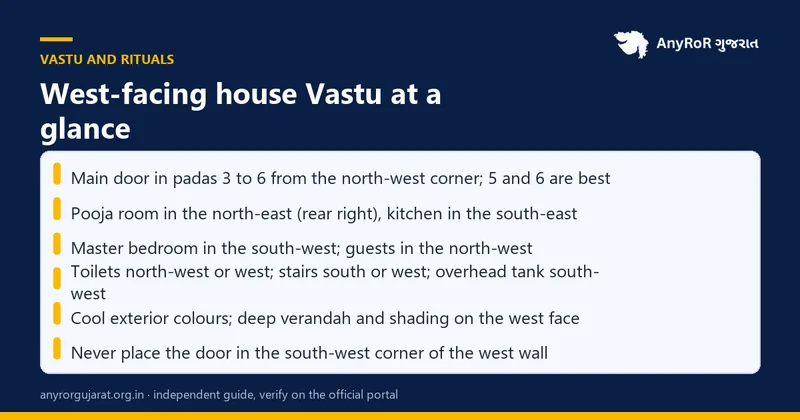
A west-facing house is not bad in Vastu; the old prejudice against it comes from the afternoon heat, not from the texts. What matters is where on the west wall the main door sits: divide the west face into 9 equal parts (padas) from north-west to south-west, and place the door in the 3rd, 4th, 5th or 6th part counted from the north-west corner. Keep the south-west heavy (master bedroom, store), the north-east light (pooja, open space), the kitchen in the south-east, and use cool colours on the west face to soften the sun. Follow those four rules and a west-facing plot is as good as any other.
Ask around an Ahmedabad society and you will hear that west-facing flats "get too hot" and that east-facing ones are "lucky". The first is a design problem with a design solution; the second is a preference the Vastu texts do not actually share. Classical Vastu treats each of the four cardinal facings as workable, with the deity Varuna presiding over the west and prosperity associated with it, provided the internal layout respects the zones.
This guide gives you the door position by pada, a room-by-room plan for a west-facing home, the placement of the pooja room, kitchen, bedrooms, toilets, staircase and water tank, colour and plant suggestions, a note on plot sizes in the vaar measurements common in Gujarat, how to apply the same logic to a west-facing flat, common doshas with their remedies, and a short comparison with the other facings. It ends with what to check on the paperwork, because the facing of a plot is recorded in the layout and the Property Card, not in the brochure.
Is a west-facing house good or bad?
Neutral to good, in the tradition. West is the direction of Varuna (water) and of the setting sun; it is associated with completion, gains and reputation. Vastu texts assign specific entrance positions to each facing and consider a west entrance in the correct pada auspicious. The two genuine issues are:
- Afternoon sun on the front face, which is a matter of overhangs, verandahs, trees, insulation and glazing.
- Layout errors that put the heavy, private rooms in the north-east or the kitchen in the north-east, which are errors in any facing.
Buyers who avoid west-facing plots leave better prices for those who understand this; in several Ahmedabad schemes a west-facing unit sells at a small discount to an identical east-facing one.
Where the main door should be: the 9 padas of the west wall
Stand outside facing the west wall of the plot. The wall runs from the north-west corner on your right to the south-west corner on your left. Divide it into 9 equal parts and number them 1 to 9 starting from the north-west.
| Pada (from north-west) | Traditional deity | Verdict for the main door |
|---|---|---|
| 1 (Roga) | Roga | Avoid |
| 2 (Papayakshma) | Papayakshma | Avoid |
| 3 (Shosha) | Shosha | Acceptable |
| 4 (Asura) | Asura | Acceptable |
| 5 (Varuna) | Varuna | Best |
| 6 (Pushpadanta) | Pushpadanta | Best |
| 7 (Sugriva) | Sugriva | Avoid |
| 8 (Dauvarika) | Dauvarika | Avoid |
| 9 (Pitru) | Pitru | Avoid strongly |
In plain terms: the door goes in the middle to slightly north of middle of the west wall, never in the south-west corner. If the plot is 40 feet wide, each pada is about 4.4 feet, so padas 5 and 6 cover roughly the 18 to 27 foot stretch measured from the north-west corner. Doors in padas 3 and 4 are used when the plan forces the door northwards.
Room-by-room plan for a west-facing house
| Room | Best zone | Acceptable | Avoid |
|---|---|---|---|
| Main door | West, padas 5–6 | Padas 3–4; a north-facing side door is a good secondary entrance | South-west corner of the west wall |
| Living room | North-west or west front | North | South-west |
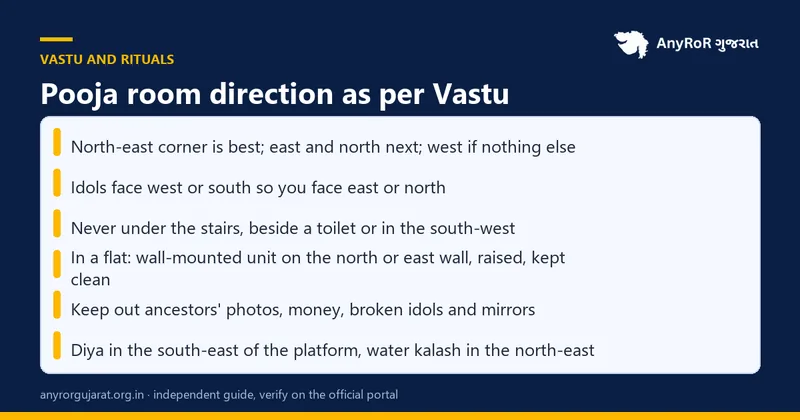
| Pooja room | North-east (rear right corner from the door) | East, north | South-west, under stairs; see the pooja room guide |
| Kitchen | South-east | North-west | North-east, south-west; see the kitchen Vastu guide |
| Master bedroom | South-west | South, west | North-east |
| Children's bedroom | East, north-east, west | North | South-west (that is for the head of the family) |
| Guest bedroom | North-west | West | South-west |
| Toilets | North-west, west, south | South-east corner of a room | North-east, centre of the house |
| Staircase | South, west, south-west | North-west | North-east, centre |
| Overhead water tank | South-west or west | South | North-east |
| Underground tank / borewell | North-east | North, east | South-west, south-east |
| Septic tank | North-west or west (not touching the boundary) | South-east | North-east, south-west |
| Parking | North-west | South-east | North-east |
| Open space / garden | North and east, kept larger than the west and south margins | Large open south-west |
The heat problem and how to design it out
- A deep verandah, otla or porch on the west front; the traditional Gujarati otla exists for exactly this reason.
- Horizontal overhangs (chajjas) and vertical fins on west-facing windows; smaller windows on the west, larger on the north and east.
- Deciduous trees or a pergola with creepers on the west side, planted outside the setback.
- Light exterior colours and a reflective or insulated roof; a cavity wall or AAC blocks on the west face.
- Put the staircase, store, toilets and the garage on the west and south-west where the heat does no harm to living rooms.
Colours for a west-facing house
Vastu and common sense agree on the west face: white, cream, light grey, pale blue, light yellow and soft beige. Inside, the west and south-west rooms take warm earthy tones (beige, peach, light brown); the north-east and east take white, light blue and light green. Avoid dark blue and black on the west exterior and bright red in the north-east.
Plants for a west-facing house
- Outside the west face: neem, ashoka or a well-placed gulmohar for shade; avoid thorny plants at the entrance.
- Inside: money plant in the south-east or north of the living room (see the money plant guide), tulsi in the north-east courtyard or balcony, areca palm and peace lily in the west rooms.
- Avoid: cactus indoors, a large tree directly in front of the main door, or a dead tree anywhere on the plot.
Plot sizes in Gujarat vaar terms
Gujarat plots are sold in square yards (vaar). Common west-facing plot sizes and how the pada rule works out:
| Plot | Approx. size | West frontage | Each pada | Door zone (padas 5–6 from north-west) |
|---|---|---|---|---|
| 100 vaar | 30 × 30 ft | 30 ft | 3.3 ft | 13.3 to 20 ft from the north-west corner |
| 150 vaar | 30 × 45 ft | 30 ft | 3.3 ft | 13.3 to 20 ft |
| 200 vaar | 40 × 45 ft | 40 ft | 4.4 ft | 17.8 to 26.7 ft |
| 300 vaar | 50 × 54 ft | 50 ft | 5.6 ft | 22.2 to 33.3 ft |
One vaar is 9 square feet; our land units guide has the full conversion table.
West-facing flats and apartments
In a flat you cannot move the entrance, so work with what you have:
- Treat the flat's own outline as the plot. Find north with a compass from the middle of the living room.
- The main door position on the west wall is fixed; if it falls in a poor pada, the usual remedies are a threshold, a bright entrance, a nameplate and a Ganesh image on the inside wall facing the door.
- Apply the zone rules inside: master bedroom in the south-west room, children in the east or north-east room, pooja unit on the north-east or east wall of the living room, no heavy storage in the north-east.
- West-facing balconies get the afternoon sun; use them for drying, a small garden or blinds, and keep the seating on the east side of the room.
Common doshas in west-facing homes and their remedies
| Dosha | Remedy commonly advised |
|---|---|
| Main door in the south-west pada (7–9) | If it cannot move, add a second door or gate in the north; keep the door well lit, install a copper strip or a Vastu pyramid above the frame, and place a heavy object inside the south-west |
| Kitchen in the north-east | Shift the stove to the south-east corner of the kitchen at least; use light colours; keep a water element in the north-east of the plot |
| Master bedroom in the north-east | Swap it with the south-west room; if impossible, sleep with head south and add earth-tone colours |
| Toilet in the north-east | Keep it closed and clean; a bowl of sea salt, a copper pyramid; move the pooja unit to the east wall elsewhere |
| Staircase in the north-east | Cannot move in a built house; keep the space under it empty and light, and strengthen the south-west with a store or heavy furniture |
| Large open space in the south-west | Plant heavy trees or build a store or garage there; raise the south-west boundary wall |
West-facing versus the other facings
| Facing | Best door padas (from the left corner as you face the wall) | Strength | Watch out for |
|---|---|---|---|
| East | 3, 4, 5 from north-east | Morning light, traditional favourite | Kitchen and toilets must stay out of the north-east; see the east-facing guide |
| North | 3, 4, 5 from north-east | Wealth zone, soft light all day | Keep the north open and low; see the north-facing guide |
| West | 3 to 6 from north-west | Prosperity and stability; often cheaper | Afternoon heat; door must avoid the south-west |
| South | 4 from south-east | Fine with the door in the correct pada | Narrow acceptable door zone; heavy south-west essential |
Check the facing on paper, not the brochure
The facing of a plot is the direction of its road-side boundary, and the approved layout of the scheme shows it. Before you pay, match the plot number, dimensions and orientation on the layout with the Property Card or 7/12 and, for a flat, with the sanctioned plan on GujRERA. Sellers sometimes describe a plot by the side that faces a garden or a wider internal road; the layout is the record.
Frequently asked questions (વારંવાર પૂછાતા પ્રશ્નો)
Is a west-facing house good as per Vastu?
Yes, when the main door is in the correct part of the west wall (padas 3 to 6 counted from the north-west corner, with 5 and 6 best) and the internal zones are respected. The tradition associates the west with Varuna and with gains; the reputation for being unlucky is mostly about afternoon heat.
Where should the main door be in a west-facing house?
In the middle or slightly north of the middle of the west wall: divide the wall into 9 equal parts from the north-west corner and use parts 5 or 6, or 3 and 4 if the plan requires. Never in the south-west corner.
Which room should be in the south-west of a west-facing house?
The master bedroom, or a store or heavy furniture. The south-west should be the heaviest, most enclosed part of the home in any facing.
Where should the kitchen be in a west-facing house?
South-east is best, north-west is acceptable. Avoid the north-east and the south-west. Cook facing east if the platform allows.
Where should the pooja room be in a west-facing house?
In the north-east, which in a west-facing house is the rear right corner as you enter. East and north walls of the living area are the alternatives.
What colour is best for a west-facing house?
White, cream, light grey, pale blue or light yellow on the exterior, which also reflects the afternoon sun. Warm earth tones inside the west and south-west rooms; light cool tones in the north-east.
How do I reduce heat in a west-facing house?
Deep verandahs or an otla on the west, chajjas and fins on west windows, shade trees outside the setback, light exterior colours, an insulated roof, and placing stairs, stores and toilets on the west and south-west.
Is a west-facing flat different from a west-facing house?
The rules are the same but you cannot move the entrance, so the emphasis shifts to placing bedrooms, the pooja unit and storage in the right zones inside the flat and managing the west balcony's sun.
Which is better, east-facing or west-facing?
Neither is better in the texts; each has a correct door zone and the same internal rules. East gets morning light and market preference; west often costs less and is equally workable with the door in padas 3 to 6.
How do I confirm which way a plot faces?
Check the approved layout plan of the scheme and the plot's boundary on the Property Card or 7/12; the facing is the side on the access road. A compass reading at the site confirms it.