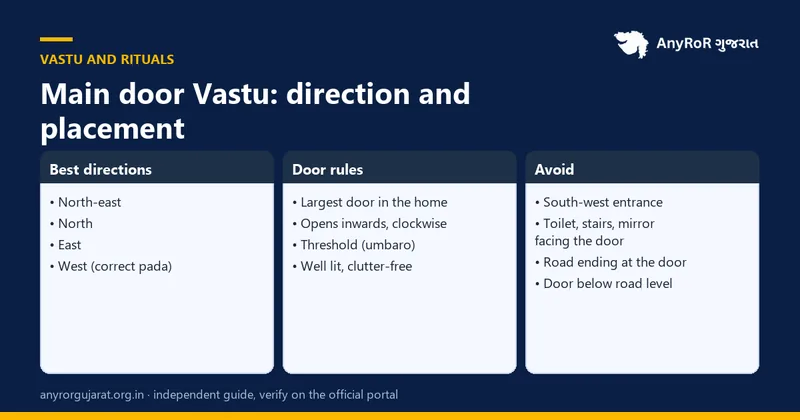
The best main door directions in Vastu are north-east, north and east, followed by west; the door should sit in the auspicious part of that wall (the middle or the part towards the north-east), open inwards and clockwise, be the largest door in the home, and have a threshold. South-west is the entrance to avoid. Paint or finish the door in a colour suited to its direction (light shades for north and east, earthy shades for west and south), keep the entrance lit and clutter-free, place Ganesh on the inside wall facing the door rather than above it, and never let a toilet, a staircase or a mirror face the main door.
Vastu calls the main door the simha dwar, the lion gate, because everything enters the home through it: people, light, air and, in the tradition, fortune. It gets more attention in the texts than any other element, and it is also the element buyers can least change in a flat. This guide gives the direction rules for an entrance, the position rules within each wall, door size, design and opening rules, colour by direction, what to place on, above and in front of the door, the specific concerns of flats and gated schemes, the common entrance doshas with remedies, and how the rules apply to a shop or office door.
Best and worst entrance directions
| Entrance direction | Vastu view | Notes |
|---|---|---|
| North-east | Best | Light, water zone; door in the north-east segment of the north or east wall |
| North | Very good | Kubera's direction; keep the north open and low |
| East | Very good | Morning sun; the traditional favourite in Gujarat |
| West | Good | In the correct pada; see the west-facing house guide |
| South | Acceptable in one narrow zone | Only the 4th pada from the south-east corner |
| North-west | Weak | Air zone; associated with instability; remedies help |
| South-east | Weak | Fire zone; linked with disputes; remedies help |
| South-west | Avoid | The heaviest zone; an entrance here is the classic dosha |
Position within the wall: the pada rule
Vastu divides each outer wall into 9 equal parts (padas). The door should fall in the parts nearer the north-east half of the wall, never in the corner parts:
- East wall: count from the north-east corner; padas 3, 4 and 5 are best.
- North wall: count from the north-east corner; padas 3, 4 and 5 are best.
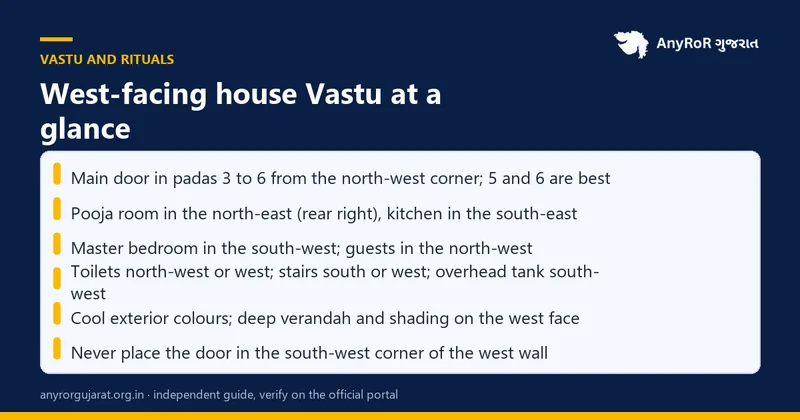
- West wall: count from the north-west corner; padas 3 to 6, with 5 and 6 best.
- South wall: count from the south-east corner; pada 4 is the accepted position.
Practically: on an east or north wall, the door goes in the half of the wall closer to the north-east corner but not in the corner itself. On a west wall, the middle or slightly north of middle. On a south wall, a little east of centre.
Size, design and opening rules
- The main door is the largest door in the home, and taller than it is wide; a common proportion is height about twice the width.
- Two shutters are traditional for an independent house; a single wide shutter is fine for a flat.
- The door opens inwards, and swings clockwise (hinges on the right when you face it from outside, in most interpretations).
- Solid wood is preferred; teak and sagwan are the Gujarati favourites. Avoid a door that is entirely glass or metal.
- A threshold (umbaro) of wood or marble, slightly raised, is auspicious and also keeps dust and water out.
- Doors should not creak, stick or drag; a door that does not open fully is considered to block fortune, and it annoys everyone.
- Avoid a door directly aligned with the back door so that you can see straight through the house.
- The main door should not be below street level, and the approach should rise slightly to it rather than descend.
Main door colour by direction
| Door faces | Recommended colours | Avoid |
|---|---|---|
| North | Light green, light blue, white, natural light wood | Red, dark brown |
| East | Natural wood, light brown, white, light green | Black, dark blue |
| West | Blue, grey, white, light wood | Red, bright yellow |
| South | Red, orange, maroon, coral, warm brown | Blue, black |
| North-east | White, cream, light yellow | Dark colours |
| South-east | Orange, peach, terracotta | Blue, black |
| North-west | White, grey, silver, light blue | Red |
| South-west | Earthy brown, beige, mustard | Blue, black, white alone |
Natural polished wood is acceptable for any direction and is what most Gujarati homes use.
What to place on, above and near the door
- Ganesh: traditionally on the inside wall facing the door so that he greets you as you enter, or on the door frame. A Ganesh image on the outside above the door is common but many Vastu consultants advise against leaving the deity's back to the home; if you keep one outside, place a second inside.
- Shubh-Labh and swastik: on either side of the door or on the frame, drawn in kumkum or as brass plaques.
- Toran: mango leaves or a permanent fabric or bead toran, changed on festivals.
- Nameplate: clear, well lit, on the right side as you face the door; a home should be easy to find.
- Doormat: clean and replaced when worn; rangoli or a swastik at the threshold on festivals.
- Light: a bright, warm light that stays on after dark. A dark entrance is the most common and most easily fixed dosha.
- Plants: tulsi in the north-east of the entrance area, or money plant; no thorny plants or dead plants at the door.
- Avoid: shoes piled at the door (use a closed rack to the side), dustbins, broken items, a dry or dead toran, and mirrors that reflect the door.
What should be in front of the main door
Open space, light and a clear approach. Vastu objects to a veedhi shoola, a road that ends straight at the door (a T-junction), to a large tree, electric pole or temple spire directly in line with the door, to a well or pit in front of it, and to the neighbour's door directly opposite at a short distance. In a flat, the lift or a staircase directly facing the door is the flat-dweller's version of the same problem.
Main door in a flat or gated scheme
- Judge the flat by its own door and outline; the tower's entrance and the scheme gate are secondary.
- The direction is fixed, so focus on what you can control: a threshold, a solid door, warm light, a nameplate, Ganesh inside, a clean lobby outside.
- Two facing flats with doors opposite each other: keep both doors well lit, avoid mirrors in either lobby view, and hang a toran; the "clash" belief is softened by distance and light.
- Lift directly opposite: a small screen or console table inside the door so that the view from the lift does not run straight into the home.
- Ask the builder for the flat's orientation on the sanctioned plan, available on GujRERA, rather than guessing from the balcony.
Entrance doshas and remedies
| Dosha | Remedy commonly advised |
|---|---|
| South-west entrance | Add a second entrance in the north or east and use it daily; raise the threshold; a copper or brass strip across the frame; a Vastu pyramid above; heavy planters either side; keep the door in earthy colours |
| South-east entrance | Orange or terracotta door colour; a small water bowl inside to the north-east; keep the kitchen fire in the south-east strong and the entrance calm |
| North-west entrance | A wind chime or bell; a solid door; a heavy planter to the west of the door |
| Toilet facing the door | Keep the toilet door closed; a curtain or partition; a plant between |
| Staircase facing the door | A console or screen to break the line; a bright light on the stairs |
| Mirror facing the door | Move it to a side wall; see the mirror Vastu guide |
| Road ending at the door (T-junction) | A compound wall or gate offset from the road line, a tulsi or shrub screen, a convex mirror outside in some traditions |
| Door below road level | Raise the threshold and the approach; steps up rather than down |
| Two doors in one line (front and back) | A screen, plant or curtain inside so the view does not pass straight through |
Shop and office entrances
The same directions apply: north, east and north-east entrances are preferred; the cash counter faces north or east; the owner sits in the south-west facing north or east; the entrance is wide, lit and free of steps that descend. For a shop on a south-facing road, keep the door in the 4th pada from the south-east corner and put the heavier stock in the south-west. Our guide on Ashant Dhara is worth reading if the shop is in an older part of Ahmedabad, since the transfer of the premises may need permission.
Entrance checklist before possession
- Direction and pada of the door checked on the plan and with a compass.
- Solid, well-fitted door; opens inwards and fully; largest door in the home.
- Threshold in place; approach level or rising.
- Colour suited to the direction; nameplate; light fitting installed.
- Nothing facing the door: toilet, stairs, mirror, lift, pole, tree.
- Ganesh inside facing the door; toran outside.
- Shoe rack and dustbin out of the entrance line.
Frequently asked questions (વારંવાર પૂછાતા પ્રશ્નો)
Which direction is best for the main door of a house?
North-east, north and east are the best entrance directions in Vastu, with west acceptable in the correct pada. The door should sit in the part of the wall towards the north-east, never in a corner, and the south-west entrance is the one to avoid.
Is a south-facing main door bad?
Not automatically. A south door is acceptable when it sits in the 4th pada counted from the south-east corner, opens inwards and the south-west of the home is kept heavy. A south-west door is the real problem.
Which way should the main door open?
Inwards, into the home, and clockwise. It should open fully without obstruction and should be the largest door in the house.
What colour should the main door be as per Vastu?
Light green, light blue or white for a north door; natural wood, light brown or white for east; blue, grey or white for west; red, orange or maroon for south. Natural polished wood suits any direction.
Where should Ganesh be placed at the entrance?
Preferably on the inside wall facing the door, so the deity looks into the home and greets you as you enter, or on the door frame. If you keep an image outside above the door, many consultants suggest a second one inside.
What should not be in front of the main door?
A road ending straight at the door, a large tree, pole or temple spire in line with it, a pit or well, a toilet or staircase inside facing it, a mirror reflecting it, shoes and dustbins, and a dark, cluttered approach.
Is a threshold necessary for the main door?
Vastu recommends a slightly raised wooden or marble threshold (umbaro); it is considered auspicious and it keeps dust and rainwater out. Most Gujarati homes have one.
What is the remedy for a south-west entrance?
Open and use a second door in the north or east if possible; otherwise raise the threshold, fit a copper or brass strip across the frame, place a Vastu pyramid above the door, keep heavy planters on either side and use earthy door colours.
Two flats with doors facing each other: is that a problem?
The tradition prefers doors not to face each other closely, but in a flat it is usually unavoidable. Keep both doors well lit, hang a toran, avoid mirrors in the lobby line and place a small screen or console inside your door.
Which direction should a shop entrance face?
North, east or north-east are preferred, with the cash counter facing north or east and the owner seated in the south-west. A south entrance is acceptable in the 4th pada from the south-east corner.