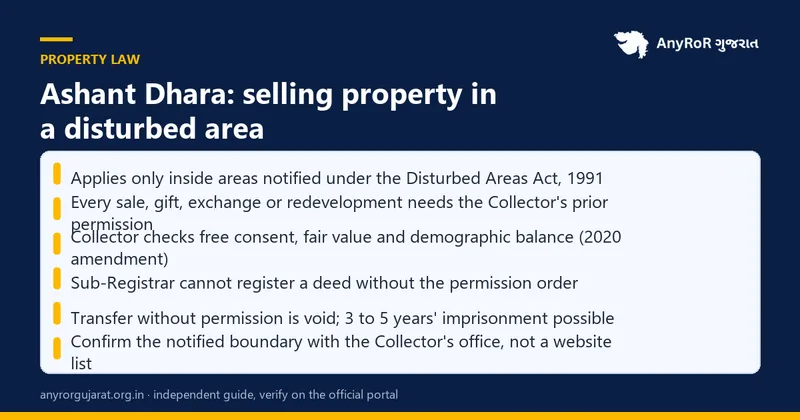
Ashant Dhara (અશાંત ધારા) is the popular name for Gujarat's Disturbed Areas Act, 1991. In neighbourhoods the government has notified as "disturbed", no house, shop or plot can be sold, gifted or exchanged without the Collector's prior permission, and the Sub-Registrar will refuse to register a deed without it. The Collector checks that the seller consents freely, that the price is fair, and, after the 2020 amendment, that the transfer will not disturb the area's demographic balance. Buying in a notified area without permission makes the deal void and can bring criminal penalties.
If you are buying or selling in parts of Ahmedabad, Vadodara, Surat, Bharuch, Himmatnagar, Godhra or a few other towns, the first question your advocate will ask is whether the address falls under Ashant Dhara. Answering it wrongly can cost months, because a transfer that needed permission and did not get it is not merely irregular; the law treats it as if it never happened.
This guide explains what the Act says in plain English, how areas get notified, what the 2019–2020 amendment changed, how to find out whether a specific property is covered, the permission procedure step by step with documents and timelines, what happens if you skip it, and how it interacts with the land-record checks you would run anyway.
What the Disturbed Areas Act is
The full title is the Gujarat Prohibition of Transfer of Immovable Property and Provision for Protection of Tenants from Eviction from Premises in Disturbed Areas Act, 1991. It was passed after the communal violence of the 1980s and early 1990s, when families in mixed neighbourhoods were pressured into selling and moving out. The Act gives the state two tools:
- Notification: the government can declare any area "disturbed" where it finds riots, mob violence or a risk of forced migration.
- Permission: inside a notified area, every transfer of immovable property needs the Collector's prior sanction, granted only after an inquiry into free consent and fair value.
It also protects tenants in those areas from eviction. In everyday Gujarati the law is simply "Ashant Dhara", the disturbed-area law.
Which areas are covered
Notifications are issued area by area, often street by street, and are extended for fixed periods, usually 5 years at a time. Parts of Ahmedabad have been under the Act almost continuously since the 1990s, and the covered zone has expanded several times, most recently to include stretches of the western city. Other notified cities and towns have included Vadodara, Surat, Bharuch, Himmatnagar, Godhra, Kapadvanj and Anand, among others. Because the boundaries are defined in the notification text, two buildings on the same road can be on different sides of the line.
How to check whether a property is under Ashant Dhara
- Ask the Sub-Registrar office for the sub-district. Their software flags survey numbers and TP final plots inside notified areas; they will tell you whether a permission is needed to register.
- Check with the Collector's office (the Ashant Dhara cell, usually under a Deputy Collector or the Resident Additional Collector) with the address, survey or city-survey number and ward.
- Read the latest notification if you want the boundaries yourself; the Home Department publishes them in the Gazette and district websites often host the map.
- Look at the Index 2 of recent sales in the same society on gARVI. Deeds registered under the Act quote the permission order number; if neighbours' deeds carry one, yours will need one too. See our Index 2 guide.
What the 2019–2020 amendment changed
The Gujarat legislature amended the Act in 2019 and the amendment came into force in 2020, followed by rules. The main changes:
| Before | After the amendment |
|---|---|
| Collector checked free consent and fair price | Collector must also assess whether the transfer could lead to "improper clustering" or "polarisation" of communities and disturb the demographic equilibrium |
| Some transfers escaped through redevelopment, gift or power of attorney | The definition of transfer was widened; redevelopment and other indirect routes are covered |
| Modest penalties | Imprisonment of 3 to 5 years and fines for transfers without permission, including for those who facilitate them |
| No dedicated review mechanism | A Special Investigation Team can look into suspected violations; the government may also review permissions |
| Registration could sometimes proceed | Registering authorities are barred from registering a transfer without the Collector's permission |
The amendment was challenged in the Gujarat High Court and parts of it have been the subject of litigation; the permission requirement itself remains in force. Treat any headline about the Act being "struck down" with caution and confirm the current position with the Collector's office.
The permission procedure, step by step
Step 1 — Agree the deal, but do not register
Sign an agreement to sell conditional on permission. Do not pay the full price and do not attempt registration; the Sub-Registrar will refuse and the attempt itself can be treated as a violation.
Step 2 — Prepare the application
The prescribed form is filed by the seller (transferor), with the buyer joining. Attach: title documents and latest Property Card or 7/12, the agreement, identity and address proofs of both sides, an affidavit by the seller stating free consent and that no pressure or inducement was involved, a valuation or the Jantri value and the agreed price, photographs, and society NOC where applicable.
Step 3 — File with the Collector's office
Applications go to the Collector or the designated Deputy Collector for the district. Several districts accept them online through the state's e-services portal; others take them at the office counter. Keep the acknowledgement number.
Step 4 — Inquiry
The office calls for a police report on the area, may seek the Mamlatdar's report on the property, and holds a hearing where the seller confirms consent in person. Under the rules the Collector is expected to decide within a fixed period from a complete application; in practice a few weeks to a few months is typical, longer if objections arise.
Step 5 — Order and registration
If satisfied, the Collector issues a permission order quoting the property and the parties. Take it to the Sub-Registrar with the deed; the order number is recorded in the registration. The permission is specific to the transaction and the parties named; a change of buyer needs a fresh application. If refused, an appeal lies to the state government within the period stated in the order.
Documents checklist
- Application in the prescribed form, signed by the seller and buyer.
- Seller's affidavit of free consent and fair value.
- Title chain: previous sale deed, Index 2, Property Card or 7/12 and 8A.
- Agreement to sell or MoU with the agreed price.
- Jantri valuation or a registered valuer's report (see the Jantri guide).
- Aadhaar, PAN and photographs of both parties; society or association NOC.
- Property tax receipt and, where relevant, the bank's consent if the property is mortgaged.
What happens if you skip the permission
- The transfer is void: title does not pass, however much was paid.
- The registering officer must refuse the deed, and a deed registered by oversight can be declared null.
- Both parties, and anyone who helped, face prosecution with imprisonment of 3 to 5 years and fines under the amended Act.
- The buyer cannot get a home loan, a name transfer on the tax bill, or mutation of the Property Card, because each of these asks for the permission order in a notified area.
- Recovering money from a seller after a void sale is a civil suit that can take years.
Tenants in disturbed areas
The second half of the Act protects tenants in notified areas from eviction except through the ordinary rent-control process, and prohibits a landlord from using the sale of the building as a way to force tenants out. A buyer of a tenanted building in a notified area therefore takes it subject to those tenancies; the Collector's inquiry will ask about them.
How Ashant Dhara fits with the rest of your checks
The permission covers the transfer. It does not verify title, encumbrances or approvals. Run the usual checks in parallel so that you are not waiting for a permission on a property you would reject anyway:
- Urban land record and Property Card for ownership, area and encumbrances.
- Index 2 on gARVI for registered deeds and earlier Ashant Dhara order numbers.
- GujRERA if the property is in a new or redevelopment project.
- Property tax no-dues certificate.
Frequently asked questions (વારંવાર પૂછાતા પ્રશ્નો)
What is Ashant Dhara in Gujarat?
Ashant Dhara is the common name for the Disturbed Areas Act, 1991. In areas the government notifies as disturbed, any transfer of immovable property needs the Collector's prior permission, granted after checking free consent, fair value and, since 2020, the effect on the area's demographic balance.
Which areas of Ahmedabad are under Ashant Dhara?
Large parts of the old city and several eastern and western neighbourhoods are notified, and the boundaries are set street by street in Home Department notifications that are renewed and expanded periodically. Confirm a specific address with the Sub-Registrar or the Collector's office rather than relying on a published list.
How do I get Ashant Dhara permission?
The seller applies to the Collector or Deputy Collector in the prescribed form with title papers, the agreement, identity proofs, a free-consent affidavit and valuation. After a police and Mamlatdar report and a hearing, the Collector issues an order that is quoted in the registered deed.
How long does Ashant Dhara permission take?
The rules set a time limit for deciding a complete application, and straightforward cases are often cleared within a few weeks to a few months. Objections, incomplete papers or a pending police report extend it.
Can I register a sale deed without Ashant Dhara permission?
No. The Sub-Registrar is barred from registering a transfer in a notified area without the Collector's order, and a transfer made without it is void and punishable.
What is the penalty for violating the Disturbed Areas Act?
Under the amended Act, imprisonment of 3 to 5 years and a fine for the parties and for anyone who facilitates an unpermitted transfer, in addition to the transfer being void.
Does Ashant Dhara apply to gifts, redevelopment or power of attorney?
Yes. The amendment widened "transfer" so that gifts, exchanges, redevelopment arrangements and powers of attorney used to move property are all covered in a notified area.
Is Ashant Dhara permission needed for a flat in a housing society?
If the society's land falls inside a notified area, yes, for every unit. The society NOC does not replace the Collector's permission.
Does the permission expire?
The order is specific to the parties and the property and is meant to be acted on promptly; a change of buyer or a long delay means applying again. Check the validity stated on the order.