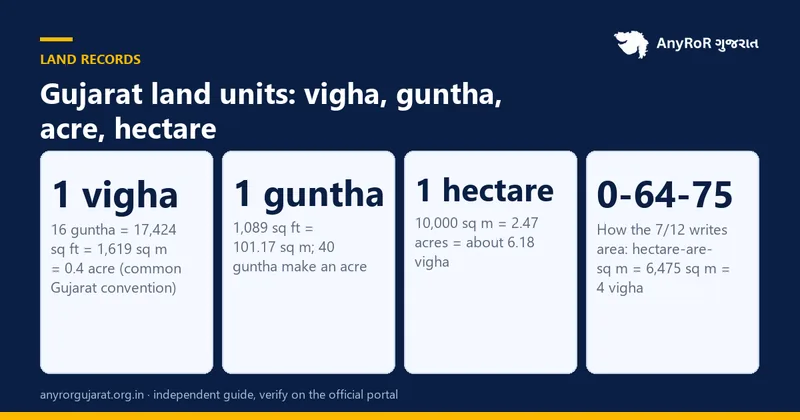
In most of Gujarat 1 vigha (bigha) = 16 guntha = 17,424 sq ft ≈ 1,619 sq m ≈ 0.4 acre, so an acre is 2.5 vigha and a hectare is about 6.18 vigha. The 7/12 Utara never uses vigha; it records area as hectare-are-square metre, for example 0-64-75 = 6,475 sq m ≈ 4 vigha. City plots are quoted in square yards (var): 1 var = 9 sq ft = 0.836 sq m. Because the vigha varies by region and even by village custom, always convert from the square metres on the record, not from what the seller says.
Ask three people in Gujarat how big a vigha is and you may get three answers, all confident. Farmers talk in vigha and guntha, brokers in square yards, the revenue record in hectares and square metres, and the Jantri table in square metres. When a deal moves from a conversation to a document, the units have to reconcile, and that is where over-payment, under-measurement and outright disputes creep in.
This guide gives you the conversion tables used in Gujarat, explains how to read the area on a 7/12 Utara and a Property Card, shows how to convert it into vigha, acres and square yards, points out the regional variations in the vigha, and works through 3 real examples (a farm, a plot and a flat) so you can check any figure a seller quotes.
The metric base: hectare, are and square metre
Every Gujarat land record is kept in metric units. The area column on a 7/12 Utara is written as three numbers separated by hyphens:
So 1-24-50 means 1 hectare + 24 ares + 50 sq m = 10,000 + 2,400 + 50 = 12,450 sq m. Do this addition first, every time; all other conversions start from the square-metre figure. A Property Card for urban land shows the area directly in square metres.
Gujarat conversion table: vigha, guntha, vasa, acre, hectare
| Unit | Square feet | Square metres | Square yards (var) | Relation |
|---|---|---|---|---|
| 1 guntha (ગુંઠા) | 1,089 | 101.17 | 121 | 1/40 acre; 16 guntha = 1 vigha |
| 1 vasa (વસા) | 871.2 | 80.94 | 96.8 | 1/20 vigha (used in parts of north and central Gujarat) |
| 1 vigha / bigha (વીઘા) | 17,424 | 1,618.74 | 1,936 | 16 guntha = 20 vasa ≈ 0.4 acre ≈ 0.1619 ha |
| 1 acre (એકર) | 43,560 | 4,046.86 | 4,840 | 40 guntha = 2.5 vigha |
| 1 hectare (હેક્ટર) | 107,639 | 10,000 | 11,960 | 2.471 acres ≈ 6.18 vigha ≈ 98.8 guntha |
| 1 are | 1,076.4 | 100 | 119.6 | ≈ 0.99 guntha |
| 1 square yard (વાર) | 9 | 0.8361 | 1 | The everyday plot unit in Gujarat cities |
The figures above use the "standard" Gujarat vigha of 16 guntha, which is what most talukas of central and south Gujarat, and most brokers, mean. Read the next section before applying it in Saurashtra or Kutch.
The vigha is not the same everywhere
The bigha was never a national standard. It was a customary unit tied to the area a pair of bullocks could plough, and it varies from about 1,600 sq m in Gujarat to over 2,500 sq m in parts of Rajasthan and Uttar Pradesh. Within Gujarat, local usage differs too:
- Central and south Gujarat (Ahmedabad, Kheda, Anand, Vadodara, Surat): 1 vigha = 16 guntha = 17,424 sq ft is the common convention.
- North Gujarat (Mehsana, Banaskantha, Sabarkantha): the same vigha, but sub-divided into 20 vasa rather than 16 guntha in conversation.
- Saurashtra and Kutch: older customary vigha figures differ and land is often discussed in acres or in "vigha" of a local size; disputes about "big vigha" and "small vigha" are common in family partitions.
None of this affects the record. The Talati enters square metres, and the Jantri is per square metre. Whenever a price is quoted per vigha, ask "how many square metres is your vigha?" and convert.
Quick formulas you can use on a phone
- Square metres → vigha:
sq m ÷ 1,618.74 - Square metres → acres:
sq m ÷ 4,046.86 - Square metres → square yards:
sq m × 1.196 - Square metres → square feet:
sq m × 10.764 - Vigha → guntha:
vigha × 16; guntha → sq m:guntha × 101.17 - Square yards → square metres:
var × 0.8361
Worked example 1: a farm on the 7/12
The 7/12 shows 0-64-75. That is 0 + 6,400 + 75 = 6,475 sq m.
- Vigha: 6,475 ÷ 1,618.74 = 4.0 vigha
- Guntha: 4.0 × 16 = 64 guntha
- Acres: 6,475 ÷ 4,046.86 = 1.6 acres
If the seller described the plot as "5 vigha", the record says otherwise: 5 vigha would be 8,094 sq m, or 0-80-94. A quarter of the price is at stake, and the difference is settled by the record and, if needed, a measurement (see the village map and FMS section of our Bhulekh guide).
Worked example 2: a residential plot in square yards
A Property Card shows a plot of 250 sq m. Brokers quote it as 250 × 1.196 = 299 var, usually rounded to "300 var". At a Jantri rate of ₹20,000 per sq m the government value is ₹50 lakh; at a quoted price of ₹25,000 per var the deal value is about ₹74.8 lakh. Both numbers are for the same plot; the conversion is what makes them comparable, and it is what the stamp duty calculation will use.
Worked example 3: a flat's carpet area
An agreement states a RERA carpet area of 82 sq m. That is 82 × 10.764 = 883 sq ft. If the brochure said "1,150 sq ft", the difference is loading for common areas, not a measurement error. Our carpet area guide explains how to compare the two.
Other units you may meet in old documents
| Term | Meaning |
|---|---|
| Anna / paisa shares | Fractions of a joint holding in pre-decimal documents: 16 anna = a full share; 4 anna = one-quarter |
| Chorasvar (ચોરસ વાર) | Square yard |
| Chorasfoot (ચોરસ ફૂટ) | Square foot |
| Pot kharabo (પોત ખરાબો) | Uncultivable portion inside a survey number, included in the total area but not in the cultivable area |
| Aakar (આકાર) | Land revenue assessment in rupees, not an area |
| Kam / part survey number (e.g. 145/2) | A sub-division of the original survey number after partition |
Why the units matter for price, tax and loans
- Price: a per-vigha price with an unstated vigha size is the most common source of over-payment on farmland.
- Stamp duty: Jantri is per square metre, so the Sub-Registrar's valuation uses the record's square metres; a deed that states area in vigha still gets valued in metric.
- Bank loans: valuers report in square metres or square feet; mismatched units between the deed, the 7/12 and the valuation report delay sanction.
- Partition: family shares are cleanest when computed in square metres and then converted, so that every heir sees the same base figure.
- NA conversion: conversion tax and premium are per square metre; see our guide to NA permission in Gujarat.
Frequently asked questions (વારંવાર પૂછાતા પ્રશ્નો)
How many square feet are there in 1 vigha in Gujarat?
By the common Gujarat convention, 1 vigha = 16 guntha = 17,424 sq ft, which is about 1,619 sq m or 1,936 sq yards. Local customary vigha sizes differ in Saurashtra and Kutch, so confirm the square metres on the land record.
How many vigha are in 1 acre?
2.5 vigha, because an acre is 40 guntha and a vigha is 16 guntha. One acre is 4,046.86 sq m or 43,560 sq ft.
How many vigha are in 1 hectare?
About 6.18 vigha. A hectare is 10,000 sq m; divide by 1,618.74 sq m per vigha.
What is 1 guntha in square feet and square metres?
1 guntha = 1,089 sq ft = 101.17 sq m = 121 sq yards. 40 guntha make an acre and 16 guntha make a Gujarat vigha.
How do I read the area on a 7/12 Utara?
It is written hectare-are-square metre, for example 0-64-75. Multiply hectares by 10,000, ares by 100, add the square metres: 0 + 6,400 + 75 = 6,475 sq m. Convert from that figure to vigha, acres or square yards.
What is 1 var (square yard) in square feet?
9 sq ft, or 0.8361 sq m. A 300 var plot is 2,700 sq ft or about 251 sq m.
Is bigha and vigha the same thing?
Yes. Vigha is the Gujarati pronunciation of bigha. The size, however, differs between states: a Gujarat vigha of about 1,619 sq m is much smaller than a Rajasthan pucca bigha of about 2,529 sq m.
What is a vasa?
A sub-unit of the vigha used in north and central Gujarat: 20 vasa = 1 vigha, so 1 vasa = 871.2 sq ft or about 80.9 sq m.
Which unit does Jantri use?
Square metres. Multiply the Jantri rate by the square metres on the record to get the government value used for stamp duty.
What if the land measures less on the ground than on the 7/12?
Apply for an official measurement (Mojani) through iORA or the DILR office. The measurement sheet becomes the basis for correcting the record or renegotiating the price. Do this before registration, not after.