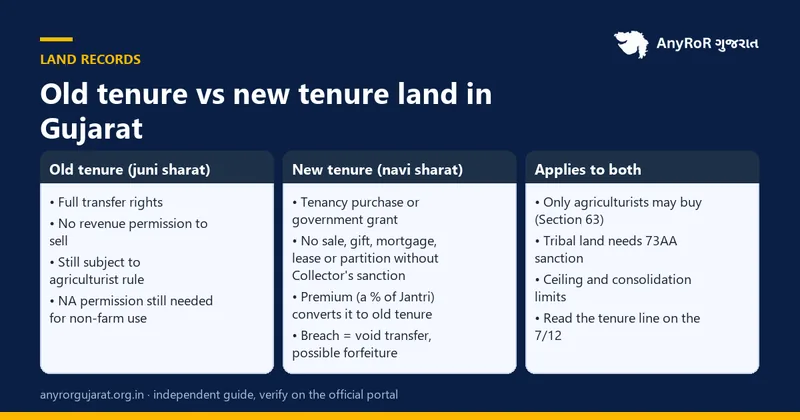
Old tenure (જૂની શરત, juni sharat) land is held with full rights: the owner can sell, gift or mortgage it to any eligible buyer without asking the government. New tenure (નવી શરત, navi sharat) land was granted or bought under conditions, usually to a tenant or a landless family, and cannot be transferred, partitioned or converted to non-agricultural use without the Collector's permission and payment of a premium. The tenure line on the 7/12 tells you which you are looking at. Two further rules apply to all farmland in Gujarat: only an agriculturist may buy it, and tribal land cannot pass to a non-tribal without sanction.
The tenure line is the shortest line on a 7/12 Utara and the one most likely to wreck a deal. Buyers read the owner's name and the area, see no bank charge, and pay a token, only to learn at the Sub-Registrar's counter that the land is new tenure and the sale cannot be registered without a permission that takes months and costs a percentage of the Jantri value. Sellers, for their part, often do not know that their inherited land carries a restriction from a grant made to a grandparent.
This guide explains where the two tenures come from, how to recognise each on the record, exactly what the restriction on new tenure forbids, how to convert new tenure to old tenure and what the premium is based on, the agriculturist rule that governs who can buy farmland at all, the tribal land rule, and a buyer's checklist that catches all three before money changes hands.
Where the two tenures come from
Gujarat inherited the Bombay land system, in which most private farmland was held under the ordinary "occupancy" tenure with full transfer rights. From the 1950s, land reform laws created a second class:
- Tenancy purchases. Under the Bombay Tenancy and Agricultural Lands Act, 1948, protected tenants became owners of the land they cultivated on the "tillers' day" (1 April 1957). Section 43 of the Act attached a condition: the land could not be sold, gifted, exchanged, mortgaged, leased or partitioned without the Collector's sanction.
- Government grants. Surplus land under the ceiling law, gauchar and waste land allotted to landless families, land given for housing to specific communities, and various regularisations were made on restricted tenure (પ્રતિબંધિત સત્તા પ્રકાર) with similar conditions.
Land carrying any of these conditions is "new tenure" or "restricted tenure". Everything else is "old tenure". The condition runs with the land through inheritance, which is why a family that has farmed a plot for 3 generations can still hold it on new tenure.
How to recognise the tenure on the 7/12
| What the record shows | Meaning |
|---|---|
| જૂની શરત / Juni sharat / Old tenure | Unrestricted occupancy. Transfer needs no revenue permission (other laws may still apply). |
| નવી શરત / Navi sharat / New tenure | Restricted. Collector's permission and premium required before any transfer or change of use. |
| પ્રતિબંધિત સત્તા પ્રકાર / Restricted tenure | Same practical effect as new tenure; usually a government grant. |
| ગણોત ધારા કલમ ૪૩ / Tenancy Act Section 43 | Land purchased by a tenant under the Act; Section 43 restriction applies. |
| બિન ખેતી / NA | Already converted to non-agricultural use; check whether the underlying tenure restriction was lifted at conversion. |
| Notes in the "other rights" column such as "premium paid, converted to old tenure, order no. ..." | The restriction was removed; the order number can be verified. |
The tenure appears in the top block of Village Form 7 alongside area and assessment. Our 7/12 reading guide shows exactly where. If the line is blank or ambiguous, the VF-6 entries that brought the land into the current holder's name will state the tenure at the time of the grant or purchase.
What new tenure forbids without permission
- Sale, gift or exchange to anyone, including relatives.
- Mortgage to a private lender (charges in favour of cooperative and nationalised banks for crop loans are generally permitted).
- Lease to another cultivator.
- Partition among heirs by registered deed (inheritance itself is recorded, but a formal division needs sanction).
- Conversion to non-agricultural use.
- Sub-division into plots.
A transfer made in breach is void, the land can be forfeited to the government, and the buyer's money is usually unrecoverable except by suit. Agreements to sell "subject to permission" are common and lawful, but the buyer should never pay more than a small token until the order is in hand.
Converting new tenure to old tenure: the premium route
Gujarat allows a holder to buy out the restriction by paying a premium (પ્રીમિયમ) to the government. The process has been moved online and simplified in stages since 2015; the current shape is:
Step 1 — Decide the purpose
Premium rates differ by what you intend to do. Conversion for continued agricultural use (so the land can be sold to another farmer) is charged at a lower percentage of the Jantri value than conversion for non-agricultural use. The percentages are fixed by government resolution and revised from time to time; ask the Prant office for the current table.
Step 2 — Apply on iORA
On iora.gujarat.gov.in choose the Premium service (new tenure to old tenure), verify your mobile, enter the survey number and upload the 7/12, 8A, the VF-6 entry showing the original grant or tenancy purchase, identity proofs of all holders and an affidavit. If you also want NA, the portal links the two applications; see our NA permission guide.
Step 3 — Site report and demand
The Mamlatdar verifies possession and that the land was not itself acquired in breach of the condition. The office computes the premium on the current Jantri value of the area applied for and raises a demand on the portal.
Step 4 — Pay and receive the order
Pay online. The Collector's order converting the land to old tenure is issued digitally and a VF-6 entry updates the 7/12. From then on the land can be sold like any old-tenure plot, subject to the agriculturist rule below.
Because the premium is a percentage of Jantri, and Jantri rates doubled in April 2023, the cost of conversion rose sharply in many villages. Look up the rate with our Jantri guide before you agree who bears the cost, buyer or seller.
Who may buy farmland at all: the agriculturist rule
Independent of tenure, Section 63 of the Tenancy Act bars the sale of agricultural land to a person who is not an agriculturist, unless the Collector permits it. In practice:
- The buyer must show they, or their family, already hold agricultural land in Gujarat (a 7/12 or 8A in their name or a parent's name). Farmers from other states have faced disputes over whether out-of-state holdings qualify; recent court decisions have addressed this, and the position should be checked with a local advocate at the time of purchase.
- A non-agriculturist can buy for a bona fide industrial purpose with a certificate under Section 63AA, or for specified educational, charitable and other purposes with permission.
- Companies and trusts are non-agriculturists unless they fall within these permissions.
- A sale in breach of Section 63 is invalid, and the land can be forfeited.
Buyers who do not qualify have two lawful routes: buy land that is already NA (no agriculturist requirement), or obtain the appropriate permission before the deed.
Tribal land: Section 73AA
Land held by a member of a Scheduled Tribe in the notified tribal areas of Gujarat cannot be transferred to a non-tribal without the Collector's prior sanction under Section 73AA of the Land Revenue Code, whatever the tenure. Such land shows a note in the record, and Sub-Registrars in tribal talukas check it as a matter of routine. Transfers in breach are void and the land is restored to the tribal holder. If you are buying in Dang, Narmada, Tapi, parts of Valsad, Navsari, Surat, Bharuch, Chhota Udepur, Panchmahal, Dahod, Mahisagar, Aravalli, Sabarkantha or Banaskantha, ask this question first.
Old tenure land is not "free of all conditions"
Even old-tenure farmland is subject to:
- the agriculturist rule above;
- ceiling limits on how much agricultural land one family may hold;
- the requirement for NA permission before non-farm use;
- consolidation (એકત્રીકરણ) rules that restrict fragmentation below a standard area in consolidated villages;
- any encumbrance, tenancy or acquisition note in the other-rights column.
Buyer's tenure checklist
- Download a fresh 7/12 and read the tenure line. Old tenure: proceed to step 4. New or restricted: proceed to step 2.
- Ask the seller for the premium order converting the land to old tenure, or make the agreement conditional on the seller obtaining it, with the cost allocated in writing.
- Verify the order number against the VF-6 entry on AnyRoR.
- Confirm your own eligibility to buy: agriculturist proof, or a permission route.
- In tribal talukas, confirm whether Section 73AA applies to the seller.
- Check the other-rights column for encumbrances and the e-Chavdi notices for pending entries.
- Pull the Index 2 to see how the seller acquired the land and whether any earlier transfer breached a condition.
- Only then pay beyond a token, and register with the correct stamp duty.
Frequently asked questions (વારંવાર પૂછાતા પ્રશ્નો)
What is the difference between old tenure and new tenure land in Gujarat?
Old tenure (juni sharat) land carries full rights of transfer. New tenure (navi sharat) or restricted tenure land was acquired under a tenancy purchase or a government grant with a condition that it cannot be sold, mortgaged, leased, partitioned or converted without the Collector's permission and payment of a premium.
How do I know if land is new tenure?
Read the tenure line in the top block of the 7/12 Utara on AnyRoR. Words such as નવી શરત, પ્રતિબંધિત સત્તા પ્રકાર or a reference to Section 43 of the Tenancy Act indicate new or restricted tenure. The VF-6 entry for the original grant confirms it.
Can new tenure land be sold?
Only after the Collector's permission, which in practice means converting it to old tenure by paying a premium through iORA, or obtaining a specific transfer permission. A sale without it is void and the land can be forfeited.
How much is the premium to convert new tenure to old tenure?
A percentage of the current Jantri value of the land, fixed by government resolution and lower for continued agricultural use than for non-agricultural use. Because Jantri doubled in 2023, check the current rate on gARVI and the current percentage with the Prant office before budgeting.
Can a non-farmer buy agricultural land in Gujarat?
Not normally. Section 63 of the Tenancy Act restricts purchase to agriculturists. Exceptions include bona fide industrial purposes under Section 63AA and other permitted purposes with the Collector's sanction. Buying land that is already NA avoids the rule.
Can new tenure land be mortgaged for a bank loan?
Crop and agricultural loans from cooperative and nationalised banks are generally allowed to be charged on new tenure land, but a private mortgage or a mortgage for non-agricultural purposes needs permission. Ask the bank; they know the local practice.
Does inheritance change new tenure to old tenure?
No. The condition passes to the heirs. A Varsai entry records the new holders, but the tenure line stays the same until a premium order converts it.
What is Section 73AA land?
Land held by a Scheduled Tribe member in Gujarat's notified tribal areas, which cannot be transferred to a non-tribal without the Collector's prior sanction under Section 73AA of the Land Revenue Code, regardless of tenure.
Is NA land old tenure?
Usually the tenure restriction is lifted (premium paid) as part of or before NA conversion, and the record shows both. Check the NA order and the tenure line together; a few older conversions carry conditions of their own.
Who pays the premium, buyer or seller?
The law does not decide this; the agreement does. Because the seller is the applicant on iORA, the order is in the seller's name, but the cost is often negotiated into the price. Put it in writing.