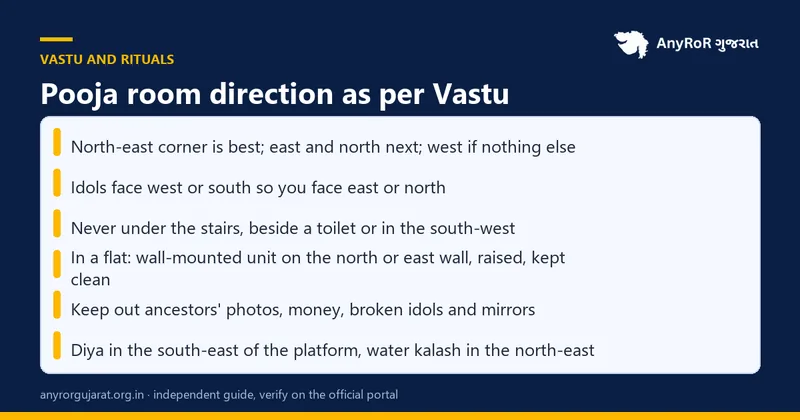
The best place for a pooja room or mandir is the north-east corner (ઈશાન ખૂણો) of the home, with the idols placed so that they face west or south and the person praying faces east or north. If the north-east is not available, east and north are the next choices, and west is acceptable. Avoid the south-west, avoid placing the mandir under a staircase or against a bathroom wall, and in a flat keep it out of the bedroom if you can. When the layout gives you no choice, a wall-mounted mandir on the north or east wall of the living room, kept clean and slightly raised, satisfies most Vastu consultants.
The pooja room is the one space in an Indian home where Vastu is followed almost universally, even by families who ignore it everywhere else. It is also the space most often compromised in modern flats, where the north-east corner is a bathroom or a balcony and the builder's "pooja niche" is wherever a wall happened to be free. The good news is that the rules are few and there is a workable remedy for nearly every constraint.
This guide gives the direction rules for the mandir and for the idols, explains why the north-east is preferred, shows what to do in a 2 BHK or 3 BHK where the ideal corner is taken, covers the bedroom and kitchen questions, lists what should never be kept in a pooja room, and ends with practical remedies and a Gujarat note on the kuldevi shrine. It is written as guidance from the Vastu tradition; how far you follow it is a personal choice.
The direction rules in one table
| Element | Best | Acceptable | Avoid |
|---|---|---|---|
| Location of the mandir in the home | North-east (Ishan) | East, north; west if nothing else | South-west, south, under a staircase, next to or above a toilet, in a basement |
| Direction the idols face | West (so you face east) or south (so you face north) | East (you face west) in some traditions | Idols facing north so you face south; idols facing each other |
| Direction you face while praying | East or north | West | South |
| Height of the idols | Chest level of a seated person; on a raised platform | Slightly above eye level in a wall unit | On the floor; above head height on a high shelf |
| Lamp (diya) placement | South-east of the mandir platform | East | Directly in front of idols where it blocks them |
| Storage for puja items | Cabinets in the south or west of the pooja area | Below the platform | Above the idols |
Why the north-east corner is preferred
In Vastu the north-east is the zone of water and of the deity Ishana, a form of Shiva, and it receives the first light of the morning sun. The tradition treats it as the lightest, calmest part of the plot, to be kept open, clean and low. A pooja room there is therefore in the quietest, brightest corner of the house, which is also good practical advice: it is away from the kitchen's heat in the south-east and the heavy storage of the south-west. The same logic explains the prohibitions: a toilet or a staircase in the north-east is considered to load the lightest corner with weight or waste.
Which way should the idols face?
The idols face the devotee, so the question is really which way you should face when praying. East is preferred (the idols therefore face west), because the rising sun is in front of you. North is the second choice (idols face south). Facing west while praying is accepted in several traditions, especially for Ganesh and for Shiva lingams. Facing south is avoided.
- Can God face south? Idols facing south means you face north, which is fine. It is you facing south that is avoided.
- Can God face north? That would put you facing south; move the platform to another wall.
- Hanuman is traditionally placed facing south in temples; at home, follow the same east-or-north rule for yourself unless your family tradition differs.
- Idols facing each other is avoided; arrange them side by side on the same wall.
Pooja room by house facing
| House facing | Where the north-east usually falls | Practical suggestion |
|---|---|---|
| East-facing | Front-left corner as you enter | Ideal case; a small dedicated room or alcove near the entrance in the north-east; see our east-facing house guide |
| North-facing | Front-right corner as you enter | Keep the north-east open and light; the mandir fits well here; see the north-facing house guide |
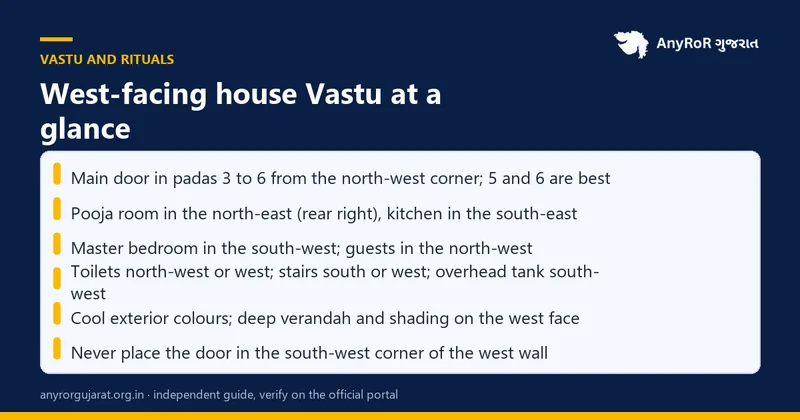
| West-facing | Back-right corner | The north-east is at the rear; place the mandir in the rear right room or on the east wall of the living area; see the west-facing house guide |
| South-facing | Back-left corner | Often a bedroom; use the north or east wall of the living room instead of forcing the mandir into a bedroom |
Pooja room in a flat or small apartment
Most Ahmedabad, Surat and Vadodara flats do not have a pooja room; they have a niche. Apply the rules in this order of priority:
- Zone first: anywhere in the north-east, east or north of the flat, even a shelf, beats a full room in the south-west.
- Wall-mounted units on the east or north wall of the living or dining area are the most common solution. Keep the base at least at waist height and leave the wall behind it plain.
- Cabinet mandirs with doors are fine; open the doors during puja.
- Avoid sharing a wall with a toilet; if unavoidable, place a wooden panel or a thin backing board behind the unit.
- Do not put it above the kitchen platform or under the AC unit: heat, smoke and dripping water are both practical and Vastu objections.
- If the only free wall is in a bedroom, use a cabinet with doors, keep the feet pointed away from it while sleeping, and close the doors at night.
Can the mandir be in the bedroom or the kitchen?
- Bedroom: avoided for a couple's bedroom in the classical texts. If there is no alternative, a closed cabinet mandir on the north or east wall, never facing the foot of the bed, is the accepted compromise. A parents' or elders' bedroom is treated more leniently.
- Kitchen: a small shelf for a kuldevi image or Annapurna is a common Gujarati practice and is acceptable in the north-east of the kitchen; a full mandir with daily havan is not. Keep it away from the stove.
- Staircase: never under the stairs; the space under stairs is used for storage or a toilet in Vastu planning.
- Basement or top floor: ground floor or the main living floor is preferred; a terrace shrine is acceptable if covered and clean.
What not to keep in the pooja room
- Broken or chipped idols and torn pictures; immerse or hand them to a temple rather than storing them.
- Photographs of departed family members: these belong on a south wall elsewhere in the home, not with the deities.
- Money, jewellery, documents or a safe.
- More than one idol of the same deity, or very large idols (traditionally not above 9 to 12 inches at home).
- Idols of aggressive forms (Bhairav, Kali in fierce form, Narasimha) unless your family tradition worships them.
- Dustbins, brooms, shoes, or the household inverter and Wi-Fi router.
- A mirror facing the idols; see our mirror Vastu guide.
Colours, materials and lighting
- Colours: white, cream, light yellow, light blue and pale green for the walls; avoid black and dark grey. Marble and light wood are preferred materials.
- Doors: a two-shutter door is traditional for a dedicated room; a threshold (umbaro) is considered auspicious.
- Light: natural light from the east if possible; warm artificial light otherwise. The diya goes in the south-east of the platform, agarbatti to the right of the deity.
- Water: a small copper kalash with water in the north-east of the platform.
- Floor: slightly higher than the adjoining room or a raised platform; never below floor level.
Remedies when the mandir is in the wrong place
| Problem | Remedy commonly advised |
|---|---|
| Mandir in the south-west | Move it to the north or east wall of any room; if impossible, keep it small, closed when not in use, and add a brass or copper base |
| Toilet in the north-east and mandir elsewhere | Keep the toilet door closed, a small copper pyramid or a bowl of sea salt in the toilet is a common suggestion; the mandir goes to the east wall of the living room |
| Mandir shares a wall with a toilet | Wooden backing panel; shift the unit a few inches off the wall |
| Idols facing north (you face south) | Rotate the platform to face west or south |
| Mandir in the bedroom | Cabinet with doors, closed at night; curtain if no doors; feet away from it |
| Mandir under a beam | Shift it out from under the beam or add a false ceiling panel |
A Gujarat note: kuldevi and the household shrine
Many Gujarati homes keep two shrines: a general mandir with Ganesh, Lakshmi, Krishna or the family's ishtadev, and a separate small place for the kuldevi (family goddess) photograph or symbol. Vastu treats both alike: north-east preferred, east or north otherwise. Families who observe a separate kuldevi corner usually place it slightly to the north of the main mandir or on the same platform to the left of the main deity. Whichever arrangement your family follows, consistency and cleanliness matter more than the exact inch.
Frequently asked questions (વારંવાર પૂછાતા પ્રશ્નો)
Which direction is best for a pooja room as per Vastu?
The north-east corner of the home, followed by east and north. West is acceptable when none of those is available. The south-west and the space under a staircase are avoided.
Which direction should God face in the pooja room?
Place the idols so that you face east or north while praying: idols on the west wall facing east-facing you, or on the south wall so you face north. Avoid arrangements where you face south.
Can God idols face south?
Yes. Idols facing south mean the devotee faces north, which is a recommended direction. What Vastu avoids is the devotee facing south.
Can a mandir be kept in the bedroom?
It is avoided in a couple's bedroom, but if there is no other space a closed cabinet mandir on the north or east wall, not facing the foot of the bed and closed at night, is the accepted compromise.
Where should the mandir be in a 2 BHK flat?
On the east or north wall of the living or dining area, wall-mounted at waist height or above, away from the toilet wall and the kitchen platform. The north-east zone of the flat is ideal if a wall there is free.
Can the pooja room be in the kitchen?
A small shelf for a kuldevi image in the north-east of the kitchen is acceptable and common in Gujarat. A full mandir with daily havan should be elsewhere, away from the stove.
What colour is best for a pooja room?
White, cream, light yellow, pale blue or light green. Marble and light wood are preferred. Avoid black and dark grey.
Should photos of ancestors be kept in the pooja room?
No. Photographs of departed family members are placed on a south wall in another room, not alongside the deities.
Where should the diya be placed in the mandir?
In the south-east of the pooja platform, the fire zone, with agarbatti to the right of the deity and a small water kalash in the north-east of the platform.
What is the remedy if the north-east has a bathroom?
Keep the bathroom door closed and the space clean, and place the mandir on the east or north wall of the living room instead. Consultants commonly suggest a small copper pyramid or a bowl of sea salt in the bathroom as a symbolic remedy.