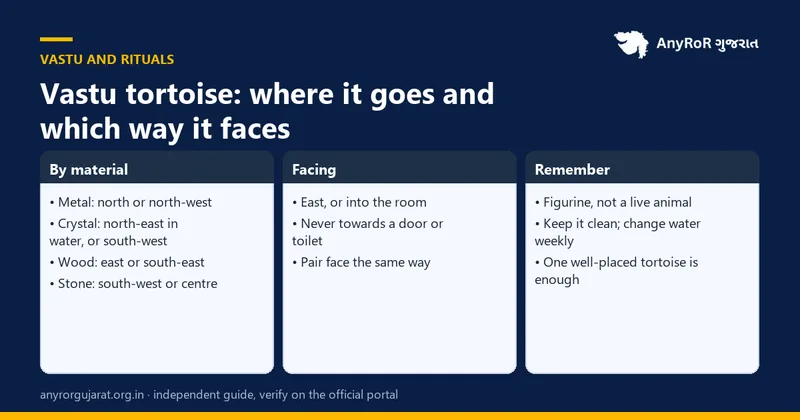
Place a Vastu or feng shui tortoise in the north of the home or the living room, facing east, or in the north-east if it is a crystal or glass tortoise kept in a bowl of water. A metal (brass or copper) tortoise goes in the north or north-west, a wooden one in the east or south-east, a crystal one in the north-east or south-west, and a black stone or resin one in the north. The tortoise should face into the room, never towards a door, a toilet or a wall it cannot "see" past. A live tortoise is not a Vastu remedy: keeping most Indian species is illegal and the tradition works with figurines.
The tortoise (કાચબો) appears in Vastu as a symbol of longevity and stability, and in Hindu tradition as Kurma, the second avatar of Vishnu, who carried Mount Mandara on his back during the churning of the ocean. Feng shui gives it a similar role as one of the four celestial animals, the black tortoise of the north that guards the back of the home. Small wonder that the tortoise figurine sells in every gift shop from Manek Chowk to Law Garden. This guide explains where to keep it, which way it faces, how the material changes the direction, the differences between the Vastu and feng shui placements, what a dragon-headed turtle is for, the office rules, the question of live tortoises and the law, and the mistakes that turn a harmless figurine into clutter.
Tortoise direction by purpose
| You want | Place it in | Facing | Material usually suggested |
|---|---|---|---|
| General stability, longevity, family health | North or living room centre-north | East | Brass, copper or stone |
| Career, income, business | North | East or into the room | Metal (brass, copper, silver-plated) |
| Wealth and savings | North or south-east | Into the room | Crystal or metal; a tortoise on a coin bed in the north |
| Peace and reduced quarrels | North-east, in water | East | Crystal or glass |
| Relationship stability | South-west | Into the room | Crystal or a pair of tortoises |
| Children's studies | East or north-east of the study room | East | Wooden or crystal |
| Protection of the home | Behind the main seating, "at the back" of the house | Towards the door it guards | Black stone or metal (feng shui placement) |
Direction by material
Both systems match the figurine's material to the element of a direction:
- Metal tortoise (brass, copper, bronze, silver): north or north-west. Metal supports the water of the north in feng shui and Kubera's direction in Vastu.
- Crystal or glass tortoise: north-east (water zone) in a shallow bowl of clean water, or south-west for relationships. Change the water weekly.
- Wooden tortoise: east or south-east, the wood element directions, good for growth and for a child's study corner.
- Stone, clay or terracotta tortoise: south-west, centre or south, the earth zones, for stability.
- Black stone or resin tortoise: north, and the feng shui "back door" guardian position.
- Silver tortoise: north, often kept in the pooja room or with the family's silver.
Which way should the tortoise face?
Into the room, or towards the east. The tortoise is said to "bring in" what it faces, so it should look into the home and not out through a door or window. Specific rules that come up:
- In the north, facing east is the standard answer.
- Never facing a toilet, a staircase or a dark corner.
- Never facing the main door head-on (that is "walking out"); a guardian tortoise placed behind the sofa faces the door only in the feng shui back-of-house placement, and then it sits behind you, not in front.
- A pair of tortoises face the same way, side by side.
Where to keep a tortoise in the house
- Living room: the north segment, on a low table or shelf, facing east. The most common and safest placement.
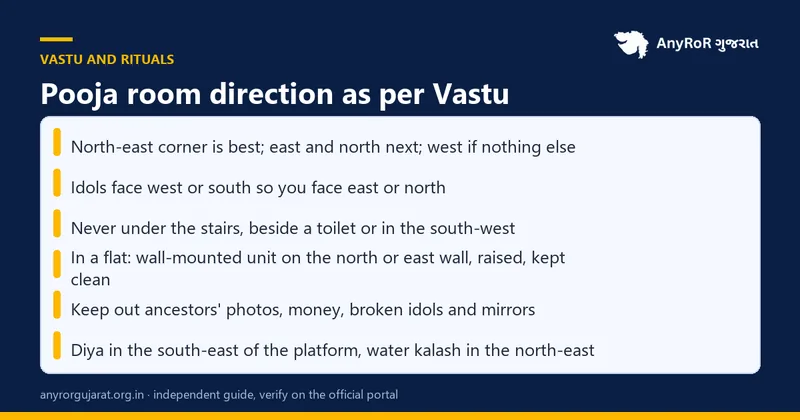
- Pooja room: a small silver or brass Kurma is traditional beside the deities; see the pooja room guide for the layout.
- Bedroom: a crystal pair in the south-west for relationship stability; not a metal tortoise, and nothing facing the bed.
- Study: a small wooden tortoise in the east or north-east of the desk.
- Garden or entrance: a stone tortoise in the north or north-east of the compound, near the water feature if there is one, facing the house.
- Kitchen: not needed; the kitchen has its own rules (see the kitchen guide).
Tortoise in the office and shop
- A metal tortoise in the north of the office, or on the north side of the owner's desk, facing east.
- Behind the owner's chair, a tortoise or a picture of one is the feng shui "support at the back" cure, especially when the chair has a window or open space behind it.
- In a shop, a brass tortoise near the cash counter in the north, facing into the shop, not towards the door.
- Keep it clean and visible; a dusty tortoise under a pile of files is a common sight and defeats the purpose.
Vastu tortoise versus feng shui tortoise
| Vastu (Kurma) | Feng shui (black tortoise) | |
|---|---|---|
| Symbol of | Vishnu's avatar; stability, longevity, dharma | One of the four celestial animals; protection, support, longevity |
| Primary direction | North, facing east | North, and "the back" of the home or seat |
| Water | Optional; crystal tortoise in the north-east bowl | Common: tortoise in a bowl of water in the north for career |
| Variants | Plain Kurma; silver in the pooja room | Dragon-headed turtle, tortoise on coins, tortoise with a baby on its back, three-tier tortoise |
| Placement logic | Direction and material | Bagua sector and the "armchair" arrangement of the home |
Indian homes mix the two freely. There is no conflict on the main point: north, facing east or into the room, kept clean.
The dragon-headed turtle
The dragon turtle (a turtle's body with a dragon's head, often standing on coins with a baby turtle on its back) is a feng shui object, not a Vastu one. It combines the tortoise's stability with the dragon's authority and is used for career and for "support". Placement: the north for career, the east for health and family, or behind the desk in an office, facing into the room. It is not placed in the bedroom or the pooja room, and it should not face a door or window.
The "lucky tortoise for money" question
Three figurines are sold under this label: the metal tortoise on a bed of coins (north, facing east), the crystal tortoise (north-east in water, or south-east), and the tortoise with a baby on its back, meant for family and descendants rather than money. If you only buy one, the brass tortoise in the north is the default. Vastu is clear that the figurine supports a home that is otherwise in order; it does not replace a tidy north, a working main door and a healthy money plant in the south-east (see the money plant guide).
Can you keep a live tortoise at home?
The Vastu answer is that the figurine is what the tradition prescribes; a live animal is not required and is not a stronger remedy. The legal answer is more important: Indian tortoise and freshwater turtle species, including the Indian star tortoise commonly offered by pet sellers, are protected under the Wild Life (Protection) Act and cannot be kept, bought or sold; the star tortoise is also listed in CITES Appendix I. Keeping one risks prosecution and, more to the point, most of these animals die in flats. Exotic species may be legal only with proper import documentation. For Vastu purposes, buy brass.
How to place a tortoise, step by step
- Find north from the centre of the room with a phone compass, away from metal furniture.
- Choose the material for the direction you have: metal for north, crystal for north-east, wood for east.
- Clean the figurine and, if it is crystal or has a bowl, fill the bowl with clean water.
- Place it on a low table or shelf, not on the floor and not above head height.
- Turn it to face east or into the room; check that it does not face a door, toilet or staircase.
- Keep it dust-free; change the water weekly; do not stack other objects on or around it.
Common mistakes
- Buying several tortoises "for every corner". One well-placed figurine is the recommendation; a pair only for the south-west.
- Placing a metal tortoise in the bedroom or a crystal one in the pooja room.
- Letting the water in a crystal tortoise's bowl go green.
- Facing it towards the main door as if it were a doorman.
- Keeping a broken or chipped figurine; replace it.
- Keeping a live protected species as a "remedy".
- Expecting a figurine to fix a north-east toilet or a south-west entrance; address the larger dosha first (see the entrance guide).
Frequently asked questions (વારંવાર પૂછાતા પ્રશ્નો)
Where should a tortoise be kept at home as per Vastu?
In the north of the home or living room, facing east, on a low table or shelf. A crystal tortoise can go in the north-east in a bowl of water; a wooden one in the east; a stone one in the south-west.
Which direction should the tortoise face?
East, or into the room. It should not face the main door, a window, a toilet or a staircase.
Which tortoise is good for money?
A brass or copper tortoise in the north facing east, often on a bed of coins, is the standard choice. A crystal tortoise in the north-east or south-east is the alternative. Neither replaces a well-kept home.
Can I keep a tortoise in the bedroom?
A crystal pair in the south-west of the bedroom is used for relationship stability. Avoid metal tortoises in the bedroom and never place one facing the bed.
Is it good to keep a live tortoise at home?
No. Vastu prescribes a figurine, not an animal, and Indian tortoise species such as the star tortoise are protected by law and cannot be kept. Buy a brass, crystal or wooden tortoise instead.
What is the difference between a Vastu tortoise and a feng shui tortoise?
Vastu sees the tortoise as Kurma, Vishnu's avatar, placed in the north facing east. Feng shui sees it as the black tortoise of the north that supports the back of the home. Both put it in the north, so the placements agree in practice.
Where should a crystal tortoise be placed?
In the north-east in a shallow bowl of clean water, facing east, for peace and clarity; or in the south-west for relationships. Change the water weekly.
Where should a tortoise be kept in the office?
In the north of the office or on the north side of the desk, facing east or into the room, or behind the owner's chair as a support cure. Keep it visible and clean.
What is a dragon turtle used for?
It is a feng shui object for career and support, placed in the north or behind a desk, facing into the room. It is not used in the bedroom or pooja room.
Can a tortoise face the main door?
Not head-on from inside, which is read as leaving the home. The only door-facing placement is the feng shui guardian position behind the main seating, where the tortoise sits behind you and looks towards the entrance.