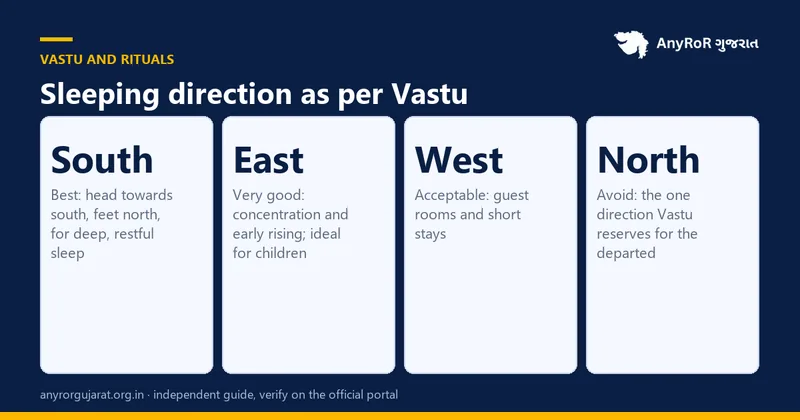
Vastu recommends sleeping with your head towards the south and feet to the north, or head towards the east. West is acceptable for guests and for short stays. Sleeping with the head to the north is the one direction to avoid. For couples, the wife on the left of the husband as they lie, the bed against the south or west wall of a south-west bedroom, and no mirror facing the bed. Children do well with the head to the east. If your room cannot give you south or east, east-west with the head east is the easy compromise.
Of all Vastu rules, the sleeping direction is the cheapest to test: turn the bed, sleep a week, judge for yourself. It is also the rule with the most folklore attached, from magnetic fields to the story of Ganesh, so it helps to separate what the tradition actually says from what the internet has added. This guide sets out the recommended directions and why, the bedroom and bed-placement rules that go with them, the specific advice for couples, children, elders and students, what to do in a flat where the bedroom is in the "wrong" corner, and what the small amount of research on sleep orientation does and does not show.
The four directions at a glance
| Head towards | Vastu view | Recommended for |
|---|---|---|
| South | Best. Associated with deep, restful sleep, stability and health | Master bedroom, elders, anyone with disturbed sleep |
| East | Very good. Associated with concentration, memory and early rising | Children, students, home offices with a day bed |
| West | Acceptable. Neutral; some texts link it to restlessness or ambition | Guest rooms, short stays, when south and east are impossible |
| North | Avoided. The head of the departed is placed north in Hindu rites; the tradition reserves it for the dead | Nobody, if it can be helped |
"Head towards south" means the crown of your head points south when you lie down, so your feet point north. People often confuse this with the direction you face when sitting up in bed.
Why south and east
The traditional explanation is that the earth is a magnet with its north pole in the north, and the human body a smaller magnet with its "north" at the head; like poles repel, so the head should point away from north to avoid a tug on the body's flow. Modern physics does not support a force strong enough to matter, but the rule predates physics and is better read as a cultural preference: south is the direction of Yama and of the ancestors, to be honoured by the head; east is the direction of the rising sun and of new energy, so waking towards it is auspicious; north, the direction of Kubera and of the final rites, is left for the departed.
Which bedroom should be which
Sleeping direction works with room placement:
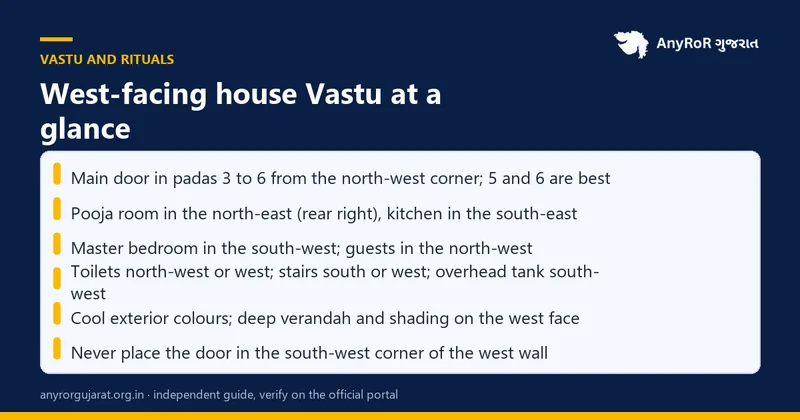
- South-west bedroom for the head of the household or the couple: the heaviest, most stable zone. Bed against the south or west wall, head south.
- South or west bedroom for elders or a second couple.
- North-west bedroom for guests and grown children who will move out: the zone of air and movement.
- East or north-east bedroom for children and students; head east. The north-east should not be a master bedroom.
- Avoid a bedroom over the kitchen, over the main door or above a garage in an independent house.
Sleeping direction for couples
- Head south, in the south-west bedroom, bed touching the south or west wall (not floating in the middle of the room and not touching the north or east wall).
- The wife on the husband's left as they lie down is the traditional arrangement (the left side is considered the Shakti side).
- A single mattress rather than two joined mattresses; the join is said to separate.
- No mirror facing the bed; if a wardrobe mirror faces it, cover it at night or move the wardrobe. See our mirror Vastu guide.
- No pooja shelf facing the foot of the bed; see the pooja room guide.
- Wooden bed frames are preferred to metal; a solid headboard against the wall.
- No beam directly over the bed; no water feature or aquarium in the bedroom.
Sleeping direction for children and students
Head to the east is the classic recommendation for children: it is linked to memory, learning and an early start. South is fine too, and for a child who struggles to settle at night, south often works better than east. The study table should face east or north, with the child's back to a wall. Avoid the north-west bedroom for a child who is unsettled; it is the zone of movement. Bunk beds are acceptable; the upper child should still have the head east or south.
Sleeping direction for elders and the unwell
Head south, bed on the south or west wall, in a bedroom on the ground floor if the house has one. For anyone recovering from illness, Vastu texts favour the south with the room's window in the east for morning light, which coincides with ordinary good sense about sleep and daylight.
Bed placement rules that go with direction
| Rule | Reason given |
|---|---|
| Headboard against a solid wall, not a window | Support and stability; also fewer drafts |
| Bed not in line with the door, and feet not pointing straight at the door | The "coffin position" in folk belief; practically, less disturbance |
| Bed not under a beam, loft or heavy hanging fixture | Pressure over the sleeper |
| Bed not touching the wall shared with a toilet | Considered draining |
| Nothing stored under the bed except linen; no shoes, tools or old papers | Clutter under the sleeper |
| Electronics, especially a TV facing the bed, kept out or covered | Mirror-like reflection and disturbance |
| Soft, warm colours on the wall behind the head | Calm; avoid bright red and black |
How to work out the directions in your bedroom
- Open the compass app on your phone, stand in the middle of the bedroom and note where north is. Move away from the wardrobe, speakers and the metal bed frame; they deflect the reading.
- Mark north on a sketch of the room; south is the opposite wall, east is to the right when you face north.
- Place the head of the bed against the south wall if that wall is solid and not shared with a toilet. If not, use the east wall.
- If the only solid wall is the north wall, turn the bed so the head is east or west along it instead, rather than accepting head-north.
- Check the door and window positions against the rules above and adjust a few inches rather than fighting the room.
What if the room only allows head-north?
First try head-east or head-west along the same wall. If the bed genuinely cannot turn (a very narrow room, a fixed built-in bed), Vastu consultants usually suggest: sleep head-west rather than north, raise the head end of the mattress slightly, keep a solid wooden headboard, and use warm colours behind the head. Nobody in the tradition suggests losing sleep over a direction you cannot change; a good night's rest is the point of the rule.
What the research says
A handful of small studies have looked at sleep orientation and reported differences in measures such as blood pressure, heart rate variability or sleep quality between north-south and east-west sleepers. The samples were small, the results mixed, and no large controlled trial exists. The honest summary is that the evidence neither confirms nor refutes the Vastu preference. What is well established is that a dark, quiet, cool room, a fixed schedule and no screens in bed improve sleep, and several Vastu bedroom rules happen to push in the same direction.
Bedroom Vastu checklist
- Head south (or east); never north.
- Couple in the south-west bedroom, bed on the south or west wall.
- Children's head east; study table facing east or north.
- No mirror or TV reflecting the bed; no pooja unit facing the bed.
- Headboard on a solid wall, no beam above, nothing but linen under the bed.
- Warm, light wall colours; soft lighting; window preferably east or north.
- Wardrobes and heavy furniture on the south or west wall of the room.
Frequently asked questions (વારંવાર પૂછાતા પ્રશ્નો)
Which direction should we sleep as per Vastu?
Head towards the south is best, head towards the east is second. West is acceptable for guests. Head towards the north is the direction Vastu asks you to avoid.
Why is sleeping with the head to the north avoided?
Traditionally because the head of the departed is placed to the north in Hindu last rites, and because of the magnet analogy in which the body's "north" at the head should point away from the earth's north. It is a cultural rule rather than a proven physical effect.
Is sleeping with the head to the east good?
Yes. East is associated with concentration, memory and early rising, and is the direction most often recommended for children and students.
Can we sleep with the head to the west?
West is acceptable, especially for guests or when south and east are not possible. Some texts link it to restlessness, so it is usually not the first choice for the master bedroom.
What is the best sleeping direction for couples?
Head south in a south-west bedroom, the bed against the south or west wall, a single mattress, no mirror facing the bed, and the wife on the husband's left as they lie down, by tradition.
Which direction should a child sleep in?
Head to the east is the classic recommendation; south also works well, particularly for a child who does not settle easily. The study table should face east or north.
Does sleeping direction affect health?
Small studies have reported mixed results and there is no large trial. The practical benefits come from the bedroom conditions Vastu also recommends: darkness, quiet, no screens and a solid, uncluttered bed.
What if my bed can only be placed with the head north?
Try turning it so the head is east or west along the same wall. If it truly cannot move, head-west is preferred over head-north, with a solid headboard and warm colours behind the head.
Should the bed touch the wall?
The headboard should be against a solid wall, ideally the south or west wall of the room, and not against a wall shared with a toilet or under a window.
Which bedroom is best for the master bedroom?
The south-west room of the house or flat. The north-east is avoided for the master bedroom, and the north-west suits guests or grown children.