Jantri (જંત્રી) is the Gujarat government's official minimum value for land and buildings, published as the Annual Statement of Rates. Stamp duty and registration fees are calculated on the Jantri value or the actual price, whichever is higher. You can check the rate for any survey number or urban zone free of charge on the gARVI portal (garvi.gujarat.gov.in) by selecting district, taluka, village or city and the land type. Rates were doubled in April 2023 and a further revision has been proposed since, so always confirm the current figure on the portal before you budget.
Every property buyer in Gujarat meets the word Jantri at least twice: once when the broker quotes a price "above Jantri" and again when the Sub-Registrar calculates stamp duty. Yet most people have never looked up the figure themselves. This guide explains what Jantri is, how it is set, exactly how to look it up online, how it feeds into the duty and fees you pay, and where it appears on your land record.
What Jantri is (જંત્રી એટલે શું)
Jantri is Gujarat's name for the guideline value, ready reckoner or circle rate used in other states. It is a table of minimum market values, per square metre, for:
- Agricultural land by village, often split into irrigated and unirrigated, and by distance from a road or town,
- Non-agricultural land and plots by village or urban value zone, and
- Built-up property such as flats, offices, shops and industrial sheds, by zone and construction type.
The table is prepared by the Revenue Department through the Superintendent of Stamps and published as the Annual Statement of Rates (ASR). Despite the word "annual", Gujarat kept the 2011 rates unchanged for over a decade, then doubled them with effect from 15 April 2023. A fresh, survey-based revision with location-wise rates was published for public objections in late 2024. Whether and when the proposed figures come into force is exactly the kind of detail you should confirm on the portal rather than rely on an article.
Why the number matters to you
| Situation | How Jantri is used |
|---|---|
| Registering a sale deed | Stamp duty and registration fee are charged on the higher of the deal price and the Jantri value. Declaring a price below Jantri does not reduce the duty. |
| Home loan | Banks compare the agreement value with Jantri as a sanity check on the valuation. |
| Income tax | If the sale price is below the stamp-duty value by more than the permitted margin, both seller and buyer can be taxed on the difference under the Income-tax Act. |
| Converting farmland to NA | The premium for non-agricultural permission is linked to the Jantri value. |
| Government land acquisition | Compensation formulas start from market value, and Jantri is one of the references. |
| Property Card | The urban record shows the Jantri value for the plot, which is a quick reasonableness check on a quoted price. |
How to check the Jantri rate online, step by step
STEP 1 — Open the gARVI portal
Go to garvi.gujarat.gov.in, the Inspector General of Registration's portal. Look for Jantri or Jantri Rate in the menu. The same lookup is linked from the Revenue Department site and from iORA. Use only addresses ending in gujarat.gov.in.
STEP 2 — Choose the location
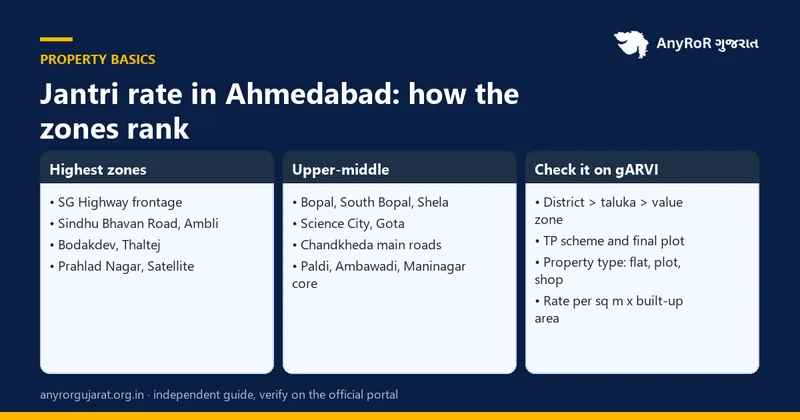
Select the District (જિલ્લો) and Taluka (તાલુકો). For rural land pick the Village (ગામ); for city property pick the City and the value zone or ward. Zone boundaries follow roads and Town Planning schemes, so a flat 200 metres away can sit in a different zone with a different rate.
STEP 3 — Choose the land or property type
Pick the category that matches the record: agricultural irrigated or unirrigated, non-agricultural plot, residential flat, office, shop or industrial. Some screens also ask for the survey number (સર્વે નંબર) or TP scheme and final plot number so the exact zone can be found.
STEP 4 — Read the rate
The result shows a rate per square metre (ચો.મી.). For land, multiply by the area on the 7/12 or Property Card in square metres. For a flat, the rate applies to the built-up or carpet area as defined in the ASR notes, sometimes with additions for floor level, parking or age of the building. Save a screenshot with the date; rates change and disputes happen.
Working out stamp duty and registration fee
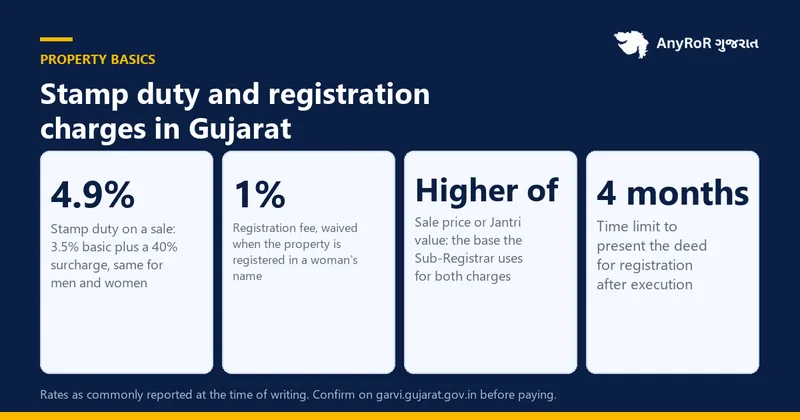
Gujarat's stamp duty on a conveyance is 4.9% of the higher of the consideration and the Jantri value: a basic duty of 3.5% plus a 40% surcharge on that duty. The registration fee is 1%, and Gujarat waives the registration fee when the property is registered in a woman's name. Figures like these are set by notification and change, so treat the following as an illustration and confirm with the Sub-Registrar or the fee calculator on gARVI:
| Item | Example |
|---|---|
| Agreed price | ₹40,00,000 |
| Jantri value (rate × area) | ₹46,00,000 |
| Value used for duty (the higher) | ₹46,00,000 |
| Stamp duty at 4.9% | ₹2,25,400 |
| Registration fee at 1% (₹0 if registered in a woman's name) | ₹46,000 |
| Approximate total government charges | ₹2,71,400 |
Notice that the duty is calculated on ₹46 lakh even though the buyer is paying ₹40 lakh. This is the single most common surprise at the registration desk, and the reason to look up Jantri before you agree a price, not after.
Where Jantri appears on your land record
- Property Card (મિલ્કત કાર્ડ): urban records on e-Milkat show a Jantri value field for the plot. See the field-by-field explanation in our Property Card guide.
- Index 2: the registration summary records the consideration and the market value adopted for duty. Comparing the two tells you whether a past deal was registered at Jantri. Our Index 2 guide shows how to pull it.
- 7/12 Utara: the rural record does not print Jantri, but the survey number and area on it are what you need for the lookup.
Common questions and mistakes
- Using the old rate. Brokers and old valuation reports may still quote pre-2023 figures. Always take the rate from the portal on the day.
- Wrong zone. In cities the zone is decided by the TP scheme and road, not by the postal area. Confirm with the final plot number.
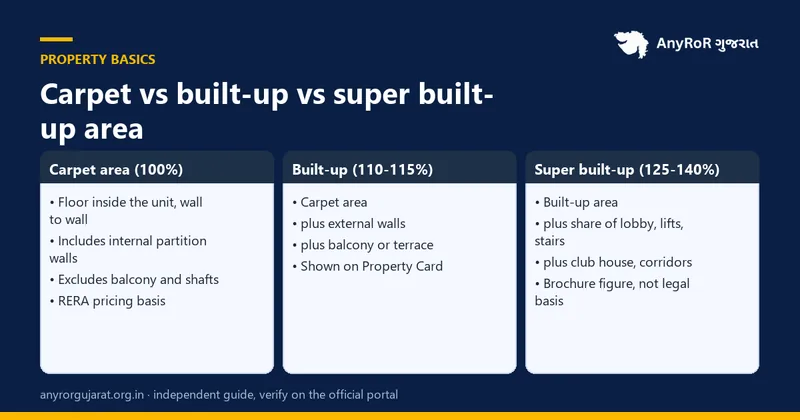
- Mixing carpet, built-up and super built-up area. The ASR specifies which area the rate applies to for flats. Using super built-up when carpet is required inflates the value.
- Assuming Jantri is the market price. It is a floor for duty, not a valuation. Market prices in many areas are well above Jantri, and occasionally below it after the 2023 doubling, which is why the "whichever is higher" rule bites.
- Ignoring the women's registration fee waiver. Registering in a woman's name can save 1% of the value legitimately.
Frequently asked questions (વારંવાર પૂછાતા પ્રશ્નો)
What is the Jantri rate in Gujarat?
Jantri is the government-notified minimum value per square metre for land and buildings, published as the Annual Statement of Rates. Stamp duty and registration fees are charged on the Jantri value or the sale price, whichever is higher. The rate differs by village, city zone and property type.
How can I check the Jantri rate of my land online?
Open garvi.gujarat.gov.in, choose the Jantri option, select your district, taluka and village or city zone, pick the land or property type and enter the survey or plot number if asked. The portal shows the rate per square metre. Multiply by the area on your 7/12 or Property Card.
When was Jantri last revised in Gujarat?
Rates were doubled with effect from 15 April 2023. A further survey-based revision was published for objections in late 2024. Check the portal for whether new rates have been notified since, because this article cannot track every notification.
Is stamp duty charged on the Jantri value or the actual price?
On whichever is higher. If you buy below Jantri, duty is still calculated on the Jantri value. If you buy above it, duty is calculated on the actual price.
Does Jantri apply to agricultural land?
Yes. Agricultural land has its own Jantri rates by village, usually distinguishing irrigated and unirrigated land and sometimes distance from a road. The same rate feeds the premium when farmland is converted to non-agricultural use.