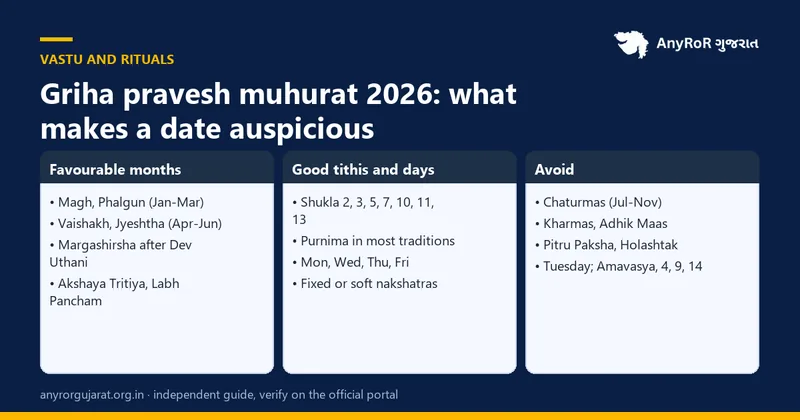
A griha pravesh muhurat is an auspicious date and time, fixed from the Hindu panchang, for entering a new home for the first time. In 2026 the favourable windows fall in the months of Magh, Phalgun, Vaishakh and Jyeshtha (roughly late January to June) and again after Dev Uthani Ekadashi in late November and December, on Shukla Paksha tithis such as Dwitiya, Tritiya, Panchami, Saptami, Dashami, Ekadashi and Trayodashi, in fixed or soft nakshatras like Rohini, Uttara Phalguni, Uttara Ashadha, Uttara Bhadrapada, Mrigashira, Chitra, Anuradha and Revati, on any day except Tuesday and, for most families, Saturday. Chaturmas (July to November), Pitru Paksha, Holashtak, Kharmas and Adhik Maas are avoided. Use this guide to shortlist dates, then confirm the exact tithi timing for your city with a panchang or your family priest.
Every year lakhs of Gujarati families take possession of a new flat or complete a house and then face the same question: when do we do the griha pravesh? Builders hand over on a working day, the vastu shanti needs a priest, relatives need notice, and the panchang has opinions about all of it. The dates published on property websites are a starting point, but they are compiled for a whole country, ignore the sunrise-to-sunrise tithi timings that shift by city, and go out of date the moment an eclipse or an adhik maas is announced.
This guide explains how a griha pravesh muhurat is actually chosen, so you can read any date list intelligently: the three kinds of griha pravesh, the months, tithis, nakshatras and weekdays that qualify, the periods that are always avoided, a month-by-month map of 2026 with the favourable and unfavourable windows, what to do when the only possible date is a "wrong" one, and a practical timeline for the paperwork that has to be finished before the puja: the possession letter, the property tax name transfer and the mutation of the Property Card.
What griha pravesh is and why the date matters
Griha pravesh (ગૃહ પ્રવેશ) is the ceremony of entering a dwelling for the first time. It is performed with a kalash, a havan or vastu shanti puja, boiling milk in the new kitchen and the family stepping in with the right foot first. In the tradition, a home entered on a favourable muhurat carries that auspiciousness forward; in practical terms the date is the moment a house becomes a home, the day you start the kitchen, move the beds in and usually the day the address changes on your documents.
The muhurat is not the same as the possession date. Many families take formal possession from the builder on any convenient day, complete the handover checklist and snagging, and hold the griha pravesh weeks later on the chosen tithi.
The three types of griha pravesh
| Type | Sanskrit name | When it applies | How strict the muhurat is |
|---|---|---|---|
| First entry into a newly built home | Apoorva (અપૂર્વ) | New construction, or a new flat never lived in | Full rules apply: month, tithi, nakshatra, weekday, lagna |
| Return after a long absence | Sapoorva (સપૂર્વ) | Re-entering a home after living elsewhere for a long period, or after renting it out | Rules apply but are applied more leniently |
| Entry after renovation or a calamity | Dwandwa (દ્વંદ્વ) | After major repairs, fire, flood or a period of vacancy for reconstruction | Simplest; a good tithi and weekday usually suffice |
Buying a resale flat that the previous family occupied is usually treated as sapoorva by priests, which widens your date choices considerably.
How a muhurat is calculated from the panchang
A panchang has five limbs (tithi, vara, nakshatra, yoga and karana). For griha pravesh the working parts are the month, the tithi, the nakshatra, the weekday and the lagna (ascendant) at the moment of entry. The date qualifies when all of them are at least neutral and none is prohibited. That is why a date can be listed as favourable in one city and not another: the tithi may end at 9:40 am in Ahmedabad, so a morning muhurat works, but the evening does not.
Favourable months
- Best: Magh (January–February), Phalgun (February–March), Vaishakh (April–May), Jyeshtha (May–June).
- Acceptable: Margashirsha (November–December) and Kartik after Dev Uthani Ekadashi, Ashadh before Devshayani Ekadashi in some traditions.
- Avoided: Chaitra in many regional traditions, and the whole of Chaturmas (Shravan, Bhadrapad, Ashwin, Kartik until Dev Uthani), Adhik Maas, Kharmas (the solar months of Dhanu and Meen, roughly mid-December to mid-January and mid-March to mid-April), Pitru Paksha and Holashtak (the 8 days before Holi).
Favourable tithis
Shukla Paksha (waxing moon) is preferred. Good tithis: Dwitiya (2), Tritiya (3), Panchami (5), Saptami (7), Dashami (10), Ekadashi (11), Trayodashi (13) and, in most traditions, Purnima. Avoid Amavasya, Chaturthi, Navami, Chaturdashi and the Rikta tithis (4, 9, 14). Krishna Paksha tithis up to Panchami are accepted by many priests when Shukla Paksha dates are impossible.
Favourable nakshatras
Fixed (sthira) and soft (mridu) nakshatras are chosen because a home is meant to last: Rohini, Uttara Phalguni, Uttara Ashadha, Uttara Bhadrapada (fixed); Mrigashira, Chitra, Anuradha, Revati (soft); and Pushya, Swati, Shatabhisha, Hasta and Dhanishtha are also used. Avoid Bharani, Krittika, Ardra, Ashlesha, Magha, Purva Phalguni, Purva Ashadha, Purva Bhadrapada, Jyeshtha, Moola and Vishakha.
Weekdays
Monday, Wednesday, Thursday and Friday are best. Saturday is avoided by most families, Tuesday almost always, and Sunday is acceptable in some regional traditions for sapoorva and dwandwa entries.
Lagna
The priest chooses a fixed lagna (Vrishabha, Simha, Vrischika, Kumbha) at the hour of entry so that the household is "settled". This is the part you cannot get from a website; it depends on your city and the exact minute.
Month-by-month map of 2026
The table shows where the favourable windows fall in 2026 by the rules above. It is a planning map, not a list of certified dates: the exact tithi start and end times for Ahmedabad, Surat, Vadodara or Rajkot must be read from a local panchang for the specific day, and eclipses or a late-announced adhik maas can remove a date.
| Month (2026) | Hindu month | Outlook | Notes |
|---|---|---|---|
| January | Paush / Magh | Poor until mid-month, good after | Kharmas (Dhanu sankranti) runs until Makar Sankranti on 14 January; Magh Shukla Paksha in late January opens the season |
| February | Magh / Phalgun | Good | Vasant Panchami and Magh Shukla tithis are traditional favourites; Phalgun Shukla dates before Holashtak |
| March | Phalgun / Chaitra | Mixed | Holashtak (8 days before Holi) and Meen sankranti (Kharmas from mid-March) close the month early |
| April | Chaitra / Vaishakh | Poor until mid-April, good after | Kharmas ends with Mesh Sankranti around 14 April; Akshaya Tritiya in Vaishakh is the single most popular griha pravesh day of the year |
| May | Vaishakh / Jyeshtha | Very good | Multiple Shukla Paksha tithis with fixed nakshatras; book priests early |
| June | Jyeshtha / Ashadh | Good until Devshayani Ekadashi | Last window before Chaturmas; in 2026 check whether an adhik maas is declared, which shifts the calendar |
| July–October | Ashadh, Shravan, Bhadrapad, Ashwin | Avoided | Chaturmas; Pitru Paksha in September–October; Navratri and Diwali are for other rituals, not griha pravesh in most traditions (some families do enter on Dhanteras or Labh Pancham by regional custom) |
| November | Kartik / Margashirsha | Good after Dev Uthani Ekadashi | Tulsi Vivah onwards; Labh Pancham is widely used in Gujarat for new beginnings |
| December | Margashirsha / Paush | Good until mid-December | Dhanu sankranti around 16 December starts Kharmas again |
Gujarat-specific customs
- Labh Pancham (the fifth day after Diwali) is treated across Gujarat as a day for new beginnings, including shop openings and home entries, and priests are booked out weeks ahead.
- Akshaya Tritiya (Akha Trij) needs no separate muhurat calculation in the tradition and is the busiest day for possession and griha pravesh in Ahmedabad and Surat.
- Vastu shanti is usually performed together with the griha pravesh in Gujarati households, with the havan in the northeast of the home.
- Kuldevi or family deity: many families first place the deity's photograph in the pooja room before anyone else enters; see our guide to pooja room direction.
What if you cannot wait for a perfect date?
Rent agreements end, loans start, schools open. Priests handle this every week:
- Treat the entry as sapoorva or dwandwa where the facts allow it, which relaxes the rules.
- Prioritise: a good tithi and weekday matter more than the perfect nakshatra, and a neutral nakshatra is acceptable.
- Perform a short vastu shanti and kalash sthapana on the best available day, move in, and hold the full griha pravesh with relatives on a proper muhurat later in the season.
- In Chaturmas, many Gujarati priests permit entry on Dhanteras, Diwali or Labh Pancham with a simplified puja, or ask you to place the kalash and light a lamp on a favourable weekday and defer the ceremony to after Dev Uthani Ekadashi.
The paperwork to finish before the puja
A griha pravesh is a good deadline for the documents that new owners tend to forget for years:
- Possession letter and completion or building-use certificate from the builder; snag list signed off.
- Registered sale deed and Index 2 copy in your file.
- Application for mutation so the Property Card or 7/12 carries your name.
- Property tax name transfer and first bill: see the AMC property tax guide.
- Electricity, gas and water connections transferred; society share certificate and membership.
- Home insurance start date aligned to the move-in.
Preparing for the ceremony
- Clean and purify the home a day earlier; salt-water mopping is traditional. Complete painting and pest control well before, since strong smells interfere with the havan.
- Torans of mango leaves and marigold on the main door, a swastik or rangoli at the threshold.
- Kalash with water, a coconut and mango leaves carried by the lady of the house; the family enters right foot first.
- Boil milk until it overflows in the new kitchen as the first cooking, then prepare something sweet.
- Vastu shanti / Ganesh puja / Navagraha havan as the priest directs; keep the northeast clear for the puja seat.
- Stay the first night in the home after the ceremony; leaving it empty the first night is avoided.
Frequently asked questions (વારંવાર પૂછાતા પ્રશ્નો)
Which months are best for griha pravesh in 2026?
Magh and Phalgun (late January to early March), Vaishakh and Jyeshtha (mid-April to June), and Margashirsha after Dev Uthani Ekadashi (late November to mid-December). Chaturmas from July to early November, Kharmas, Pitru Paksha and Holashtak are avoided.
Which tithis are good for griha pravesh?
Shukla Paksha Dwitiya, Tritiya, Panchami, Saptami, Dashami, Ekadashi and Trayodashi, and Purnima in most traditions. Chaturthi, Navami, Chaturdashi and Amavasya are avoided.
Which day of the week is best for griha pravesh?
Monday, Wednesday, Thursday and Friday. Tuesday is avoided, Saturday is avoided by most families, and Sunday is accepted in some regional traditions for re-entry ceremonies.
Can griha pravesh be done in Chaturmas or Shravan?
The classical rule says no for a first entry. In practice many Gujarati priests allow a simplified entry on Dhanteras, Diwali or Labh Pancham, or a kalash sthapana on a favourable weekday with the full ceremony after Dev Uthani Ekadashi.
Is Akshaya Tritiya good for griha pravesh?
Yes. Akshaya Tritiya (Akha Trij) is regarded as an abujh muhurat, auspicious without further calculation, and is the most popular griha pravesh day in Gujarat. Book the priest early.
What is the difference between griha pravesh and vastu shanti?
Griha pravesh is the act of entering the home on a muhurat; vastu shanti is the puja that pacifies the vastu purusha and the elements of the plot. In Gujarat they are usually performed together on the same morning.
Can we move furniture in before the griha pravesh?
Most priests allow furniture and fittings to be installed beforehand as long as nobody sleeps or cooks in the home. The kalash entry, first cooking (boiling milk) and first night follow the muhurat.
Do I need a separate muhurat for a resale flat?
A previously occupied flat is generally treated as sapoorva griha pravesh, so the rules are applied more leniently, but a good tithi and weekday are still chosen and a vastu shanti is common.
Why do different websites list different griha pravesh dates?
Because tithis and nakshatras begin and end at specific times that vary by location, and because some sites include Krishna Paksha or Sunday dates that others exclude. Use the rules to judge any list, and confirm the hours with a local panchang.
What paperwork should be done before griha pravesh?
Possession letter and completion certificate, registered sale deed with Index 2, mutation application for the Property Card or 7/12, property tax name transfer, utility transfers and society membership. The ceremony is a good deadline for all of them.