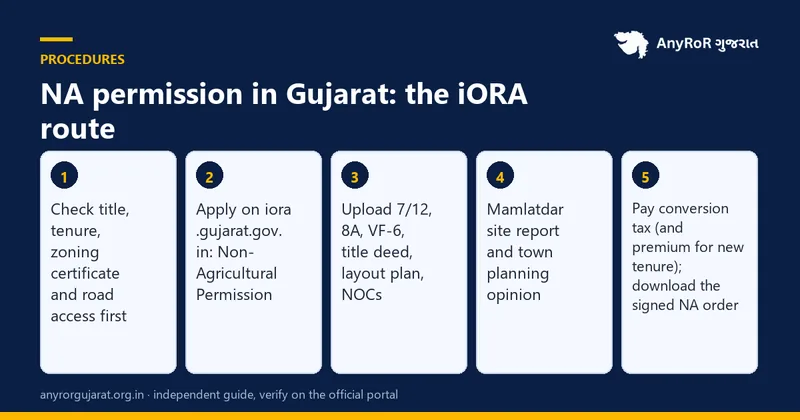
NA permission (બિન ખેતી પરવાનગી) is the Collector's order under Section 65 of the Gujarat Land Revenue Code that lets agricultural land be used for a house, shop, factory or any other non-farm purpose. In Gujarat you apply online through the iORA portal with the 7/12, 8A, title documents, a layout plan and zoning certificate, pay the conversion tax (and a premium if the land is new tenure), and receive a digitally signed NA order. Building or selling plots on farmland without it is illegal and the structure can be removed. Land inside approved development-plan zones follows a faster route.
Every plotted scheme, farmhouse, warehouse and roadside shop on what used to be a field in Gujarat has, or should have, an NA order behind it. The order changes the legal character of the land from agricultural to non-agricultural, fixes the permitted use, and switches the revenue from a few rupees of assessment to non-agricultural assessment. It is also the document banks ask for before lending on a plot, and the one buyers of "NA plots" most often fail to verify.
This guide explains when NA permission is needed, the three routes (regular, development-plan area and bona fide industrial use), the iORA application step by step, the documents, the taxes and premium, timelines, the special case of new-tenure land, what an NA order looks like and how to verify one, and the mistakes that get applications rejected or plots stuck for years.
When you need NA permission
- Building a house, farmhouse, hostel or any residential structure on agricultural land.
- Setting up a shop, showroom, petrol pump, hotel, school, hospital or office.
- Starting a factory, warehouse, cold storage or godown.
- Dividing farmland into plots for sale, whether or not you build.
- Changing an existing NA use to another use, for example residential to commercial (a fresh or amended order is needed).
You do not need NA permission for purely agricultural structures such as a pump house, cattle shed or a small storage room for produce, or for a residential building within the limits allowed to an agriculturist on their own farm under the Code. When in doubt, the Mamlatdar's office will tell you which side of the line a proposed use falls.
The three routes to NA
| Route | Applies to | Authority | Key feature |
|---|---|---|---|
| Regular NA (Section 65) | Any agricultural land outside the special cases below | Collector (delegated to Deputy Collector / Prant Officer in many districts) | Full scrutiny: title, tenure, zoning, access, NOCs |
| Development-plan area | Land inside a sanctioned Development Plan or Town Planning scheme zone (AUDA, SUDA, VUDA and similar) | Collector, with a simplified check | Use must match the zone; Gujarat's reforms since 2017 allow near-automatic permission on payment where the zone allows the use |
| Bona fide industrial purpose (Section 65B) | Land bought or held for a genuine industrial unit | Collector, by intimation | The industry may start after filing the prescribed intimation and paying dues; the Collector can object within the statutory period |
A fourth, related route is Section 63AA of the Tenancy Act, which allows a non-agriculturist to buy farmland for a bona fide industrial purpose with the Collector's certificate, since Gujarat otherwise restricts purchase of agricultural land to agriculturists. Our guide to old and new tenure land covers those purchase rules.
Before you apply: the checks that decide the outcome
- Title and possession. The applicant must be the holder on the 7/12, with all co-holders joining. Pending mutation entries or a disputed 135-D notice will stall the file; clear them first (see the mutation guide).
- Tenure. Old tenure (જૂની શરત) can be converted on payment of conversion tax. New tenure (નવી શરત) needs a premium to lift the restriction, sometimes as a separate prior step.
- Zoning. Get the zoning certificate from the urban development authority or the town planning office. Residential NA in an agricultural zone will be refused; an industrial zone will not get residential NA.
- Access. The plot must touch a public road, or you must show a registered right of way. Landlocked plots are a frequent refusal ground.
- Encumbrances. A bank charge on the 7/12 needs the bank's consent; a court stay blocks the application.
- Reservations. Check the Development Plan for road widening, gamtal (village site) extension, canal or forest reservations touching the survey number.
How to apply for NA permission on iORA
Step 1 — Open iORA and select the service
Go to iora.gujarat.gov.in, choose Online Application, then the Non-Agricultural Permission service (listed with its purpose options: residential, commercial, industrial, institutional). For new-tenure land you will also see the Premium service; the portal guides which comes first for your case.
Step 2 — Verify your mobile and open the form
Enter mobile and email, confirm the OTP, and the application form opens with a reference number. Save it; every later status update quotes it.
Step 3 — Enter the land details
District, taluka, village, survey or block number and the area to be converted (all or part). The portal pulls the current holders from the record; every holder must be listed as an applicant with identity proof.
Step 4 — Upload the documents
Scan each document as a clear PDF. The list below is what most districts ask for; the portal shows the mandatory ones for your route.
Step 5 — Pay the scrutiny fee and submit
A small application fee is paid online. The application is routed to the Mamlatdar for the site report, to the town planning office for the zoning opinion, and to any other department whose NOC is needed.
Step 6 — Pay the demand and download the order
When the file is approved in principle, the portal raises a demand for conversion tax, premium (if any) and NA assessment. Pay online. The digitally signed NA order (sanad) is issued on the portal and a mutation entry is made in Village Form 6 recording the new use. Track everything under Application Status.
Documents checklist
- Latest 7/12 (VF-7) and 8A; VF-6 entries showing how the applicant acquired the land.
- Title documents: sale deed with Index 2, or inheritance and partition papers.
- Title clearance certificate from an advocate (commonly asked for larger areas).
- Village map extract or field measurement sheet showing the plot and the road.
- Layout or site plan prepared by a licensed engineer or architect, showing the proposed use and margins.
- Zoning certificate / Part plan from the development authority or town planner.
- NOCs where relevant: gram panchayat, irrigation (if a canal is within the distance limit), highways (for plots on a state or national highway), pollution control board (for industry), airport authority (near airports), railways.
- Bank consent if the land is mortgaged; court order copies if there was litigation.
- Identity and address proofs of all holders; photographs; an affidavit in the prescribed form.
Costs: conversion tax, premium and NA assessment
| Charge | What it is | How it is worked out |
|---|---|---|
| Conversion tax (રૂપાંતર કર) | One-time tax for changing use from agricultural to non-agricultural | Per square metre, at rates fixed by government resolution that rise with the size of the town or city and with the use (industrial and commercial higher than residential) |
| Premium (પ્રીમિયમ) | Payable only for new-tenure or restricted land, to remove the restriction | A percentage of the current Jantri value, set by resolution and depending on the purpose; agricultural-to-agricultural conversion is cheaper than agricultural-to-NA |
| NA assessment (બિન ખેતી આકાર) | Annual land revenue after conversion | Per square metre per year, again by class of town and use |
| Scrutiny and mutation fees | Portal and e-Dhara fees | Small fixed amounts |
Because the premium is a percentage of Jantri, look up the rate first (see the Jantri guide); after the 2023 doubling of Jantri rates, premium became the largest cost in many new-tenure conversions. The government publishes the current conversion tax and premium tables; ask the Prant office or your consultant for the figures that apply to your village class.
Timelines and tracking
Gujarat's citizen charter and the online workflow aim to dispose of a complete NA application within a few weeks for development-plan land and within about 1 to 2 months for regular cases; files that need multiple NOCs take longer. Each stage is visible on iORA under Application Status, and the reasons for a query (e.g. missing NOC, road access not established) are posted there. Reply to queries through the portal rather than in person where possible, so the file keeps its date.
How to verify an existing NA order before buying a plot
- Ask the seller for the NA order and the layout it approved; check the survey number, area and permitted use match the plot you are buying.
- Open the 7/12 for the survey number: after NA, the tenure line should read non-agricultural (બિન ખેતી) with the order number and date entered through a VF-6 entry.
- For land in a city or town, check whether a Property Card has been opened for the plot on e-Milkat.
- Confirm the layout plan was approved by the development authority and that your plot exists on it with the same number.
- Check that NA assessment has been paid (receipt) and that no condition of the order (for example, construction within a time limit) has been breached.
Common reasons for rejection or delay
- Proposed use does not match the zone in the Development Plan.
- No legal road access, or access only through another person's field without a registered right.
- Pending mutation, missing co-holder signatures, or a bank charge without consent.
- New-tenure land applied for without the premium step.
- Land within a restricted distance of a highway, canal, railway line, defence installation or airport without the NOC.
- Land under acquisition, reservation or a court stay.
- Tribal land under Section 73AA without the required sanction.
After the order: what changes on the record
The NA order triggers a VF-6 entry, the 7/12 tenure line changes to non-agricultural with the permitted use, and the assessment column shows NA assessment. In urban areas the City Survey Office may open a Property Card. If you then sub-divide into plots, each plot gets its own number on the approved layout and, in a city, its own Property Card. Buyers of your plots will check all of this, so keep the order, the layout, the assessment receipts and the updated record together.
Frequently asked questions (વારંવાર પૂછાતા પ્રશ્નો)
What is NA permission in Gujarat?
It is the Collector's order under Section 65 of the Gujarat Land Revenue Code permitting agricultural land to be used for a non-agricultural purpose such as housing, commerce or industry. It fixes the permitted use and changes the land revenue to NA assessment.
How do I apply for NA permission online in Gujarat?
Through iora.gujarat.gov.in: choose Online Application → Non-Agricultural Permission, verify your mobile, enter the survey number and area, upload the 7/12, 8A, title papers, layout plan, zoning certificate and NOCs, pay the fee, and later pay the conversion tax and premium demand. The signed order is issued on the portal.
How long does NA permission take?
Development-plan land with a matching zone is often cleared within a few weeks of a complete application; regular cases take about 1 to 2 months, longer where several NOCs are needed. Track the file under Application Status on iORA.
What does NA conversion cost?
A one-time conversion tax per square metre that depends on the town class and use, plus a premium (a percentage of Jantri value) if the land is new tenure, plus annual NA assessment and small fees. The tables are set by government resolution; the Prant office can give the figures for your village.
Can a non-farmer buy agricultural land in Gujarat and convert it?
Only an agriculturist can normally buy farmland in Gujarat under Section 63 of the Tenancy Act. A non-agriculturist can buy for a bona fide industrial purpose with the Collector's certificate under Section 63AA, or buy land that is already NA. Buying farmland first and applying for NA later is not available to a non-agriculturist.
Is NA permission needed inside a Town Planning scheme?
Yes, but the route is simplified: where the Development Plan zone permits the use, the permission is granted on payment with a lighter check. The use must still match the zone.
What is the difference between NA permission and building permission?
NA permission changes the land's legal use and comes from the Collector. Building permission (development permission) approves the actual construction and comes from the municipal corporation, urban development authority or panchayat. You need both to build.
Can NA permission be cancelled?
Yes, if a condition of the order is breached, for example the land is used for a different purpose or construction does not start within the stated period. The Collector can also impose penalties for unauthorised NA use.
How do I check whether a plot is NA?
Open the 7/12 for the survey number on AnyRoR: after conversion the tenure line shows non-agricultural with the order number, and a VF-6 entry records it. Ask the seller for the order and the approved layout and match the plot number.
Do I need NA permission for a farmhouse?
A dwelling for the farmer within the limits allowed under the Code may not need it, but a farmhouse used as a weekend home, rented out or built beyond those limits does. Check with the Mamlatdar before building.