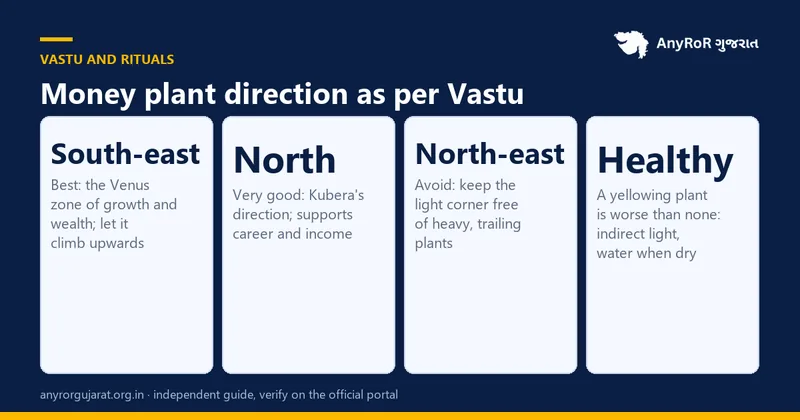
Keep a money plant in the south-east of the home or of the living room, the direction of Venus and of growth, or in the north, the direction of Kubera. Let it climb upwards on a support rather than trail on the floor, keep it indoors or on a shaded balcony, and never let it dry out or yellow. Avoid the north-east (the light, open corner) and do not place it against an east or north-facing outer wall where it is exposed to harsh sun. Water-grown plants in a glass jar are fine; a green pot or a blue or green glass jar suits the plant's element. Gifting a cutting from a healthy plant is considered better than buying one.
The money plant (Epipremnum aureum, pothos, golden pothos; મની પ્લાન્ટ in Gujarati homes) is the most common indoor plant in India for two reasons: it survives neglect, and it carries a name that promises prosperity. Vastu and feng shui both give it a place, and both give more detail than "put it anywhere green". This guide covers the direction rules and the reasoning, placement room by room including the office, the directions and spots to avoid, pot and support choices, soil versus water, the varieties commonly sold in Gujarat nurseries, care that keeps it Vastu-compliant (a dying money plant is worse than none), remedies, and the mistakes people make when they rearrange the house around one plant.
The direction rules
| Direction | Vastu view | Reasoning in the tradition |
|---|---|---|
| South-east | Best | Zone of Venus (Shukra), associated with wealth, comfort and growth; the plant's upward climb "feeds" it |
| North | Very good | Kubera's direction, the treasury of the home; a climbing plant here is said to support career and income |
| East | Acceptable | Growth and health; keep it inside, away from direct sun through the window |
| West, south | Neutral | Fine for a healthy plant; no particular benefit claimed |
| North-east | Avoid | The lightest, most open corner; a heavy, trailing plant is thought to weigh it down |
| South-west | Avoid for a climber | The stability zone; plants that grow fast and spread are kept out of it |
Feng shui reaches a similar answer by a different route: the south-east is the wealth corner in the bagua, and a rounded-leaf plant there is the classic cure. Where Vastu and feng shui agree, families in Gujarat tend to follow without argument.
Where to place a money plant in the house
- Living room: the south-east corner, on a stand or shelf, with a moss stick or a thin trellis so the vine climbs. A second plant in the north corner of the room is common.
- Bedroom: acceptable in the south-east of the room, at least 3 feet from the bed; not on the bedside table, not at the foot of the bed. Some consultants prefer no plants in a couple's bedroom; if you keep one, keep it small and healthy.
- Kitchen: a small plant in the south-east of the kitchen is fine; keep it away from the stove's heat and steam. Do not put it in the north-east of the kitchen if that corner is used for water.
- Balcony: a north or east balcony with filtered light is ideal; a west balcony gets afternoon sun that scorches the leaves.
- Bathroom: avoided in Vastu, and the plant does not enjoy the humidity swings either.
- Entrance: a money plant to the side of the main door (not directly in front) is common; see the entrance Vastu guide.
Where to place a money plant in the office
- On the desk to the left front (north-east quadrant of the desk) or in the south-east corner of the cabin.
- In an open office, the south-east and north of the floor plan; near the accounts or cash section in the north is a common request.
- Water-grown plants in glass jars are popular on desks; change the water weekly so it never smells.
- Avoid placing it where it blocks the door swing or trails onto the floor between desks.
Where not to place a money plant
- Not in the north-east corner of the home or room.
- Not on the floor with vines trailing downwards; give it a support and let it climb.
- Not outside where it takes direct afternoon sun; leaves burn and pale.
- Not on a cracked or chipped pot, and not in stagnant, smelly water.
- Not touching the ground or a wall in a way that lets the vine root into the soil outside; the tradition prefers it contained.
- Not in the bathroom, and not in the pooja room (see the pooja room guide for what belongs there).
- Not in the south-west corner of the plot as a fast climber.
Pots, supports and colours
- Pot colour: green, blue or terracotta are the usual suggestions; white and cream are neutral. Avoid black pots in the south-east, the fire zone, in some traditions.
- Material: clay or ceramic for soil; glass for water. Metal pots are considered less suitable for a wood-element plant in feng shui.
- Support: a coir moss stick, a bamboo stake or a small trellis. Upward growth is the whole point in Vastu; a plant left to trail downward is said to signal decline. Trim and redirect vines that head for the floor.
- Height: raised on a stand or shelf rather than on the floor.
Soil or water?
| Soil | Water | |
|---|---|---|
| Vastu view | Preferred for long-term growth; earth element grounds the plant | Acceptable, especially in the north (water zone) and on desks |
| Growth | Faster, bigger leaves | Slower, smaller leaves |
| Care | Water when the top inch is dry; well-draining mix | Change water every 5 to 7 days; rinse roots; a drop of liquid fertiliser monthly |
| Risks | Overwatering and root rot | Algae and smell if the water is not changed |
| Best for | Living room and balcony plants | Kitchen shelf, office desk, bedroom in a small jar |
Varieties you will find in Gujarat nurseries
- Golden pothos (green with yellow marbling): the standard money plant, toughest of all.
- Marble queen (heavy white variegation): needs brighter indirect light or it turns green.
- Neon pothos (lime green): popular for north corners; keep out of direct sun.
- Jade pothos (plain deep green): tolerates lower light, good for interiors away from windows.
- Silver or satin pothos (Scindapsus pictus): related, sold as money plant; slower and more sensitive to overwatering.
- Split-leaf "money plant" (Rhaphidophora or Monstera sold under the name): bigger and heavier; treat it as a floor plant for the south-east of a large living room.
Care that keeps the plant Vastu-compliant
The single rule that matters most is that the plant should be alive and green. A yellowing, wilting or leggy money plant is considered worse than no plant, so care is part of the Vastu:
- Bright indirect light; an east or north window a metre or two away is ideal. No direct afternoon sun.
- Water when the top 2 to 3 cm of soil are dry, roughly every 5 to 8 days in Gujarat's climate, less in winter. Yellow leaves usually mean too much water, brown crisp edges too little or too much sun.
- Wipe the leaves monthly; dust blocks light and looks neglected.
- Prune vines that trail down and pin new growth upwards; use the cuttings to start new plants for gifting.
- Feed lightly with a balanced liquid fertiliser once a month in the growing season.
- Repot every 2 years or when roots circle the pot; choose a pot one size larger.
- Keep it out of reach of pets and small children; the sap is mildly toxic if chewed.
Remedies and common beliefs
| Situation | Commonly advised |
|---|---|
| Plant kept in the north-east for years | Move it to the south-east; place a small water bowl or a light plant such as tulsi in the north-east instead |
| Plant keeps dying in the chosen corner | The corner is too dark or too hot; move it a metre towards indirect light before changing direction again; a plant that dies repeatedly is a care problem, not a curse |
| Vines trailing to the floor | Install a moss stick and tie the vines upward; trim the tips |
| Bought versus gifted | Tradition favours a cutting from a thriving plant in a friend's or relative's home; a bought plant is fine, but ask the nursery for a healthy, rooted specimen |
| Giving away your money plant | Giving a cutting is auspicious; giving away the whole plant is avoided by the superstitious |
| Plant in the bedroom of a couple | Keep it small, in the south-east, away from the bed, or move it to the living room |
Combining the money plant with other Vastu elements
- Tulsi in the north-east and money plant in the south-east is the classic pairing in Gujarati homes: light and sacred in the light corner, growth in the growth corner.
- Aquarium or water bowl in the north with the money plant beside it, not in it.
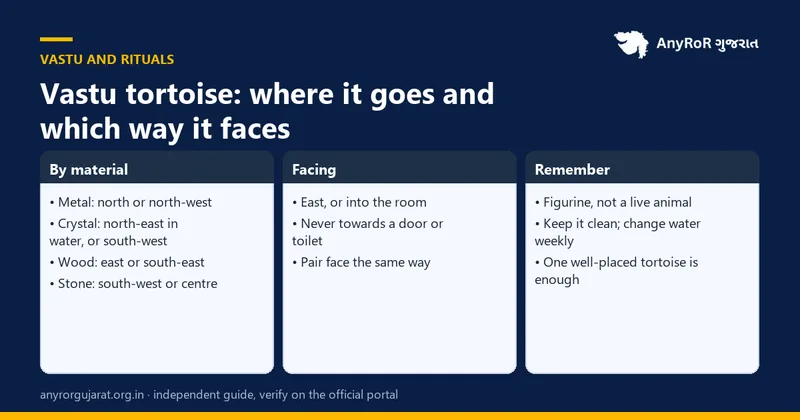
- Crystal or metal tortoise in the north (see the tortoise Vastu guide) and money plant in the south-east; keep them in their own zones rather than stacking cures in one corner.
- Mirror: do not place a mirror to "double" the plant in the south-east; mirrors belong on north and east walls (see the mirror guide).
Mistakes to avoid
- Rearranging the whole house around one plant. The plant is a small element; the main door, kitchen and master bedroom carry far more weight in Vastu.
- Buying five plants for five corners. One or two healthy plants in the right zones are the recommendation.
- Treating a yellowing plant as a sign rather than a watering problem.
- Placing it in the north-east because that corner "needs something".
- Letting it climb the outside of the building or a neighbour's wall from a balcony.
Frequently asked questions (વારંવાર પૂછાતા પ્રશ્નો)
Which direction is best for a money plant as per Vastu?
The south-east of the home or room, the zone of Venus and growth, is the first choice. The north, Kubera's direction, is the second. Keep it climbing upwards on a support and in bright indirect light.
Where should a money plant not be kept?
Not in the north-east corner, not in the bathroom or pooja room, not in direct afternoon sun, not trailing on the floor, and not in a cracked pot or stagnant water.
Can a money plant be kept in the bedroom?
Yes, in the south-east of the room, a few feet from the bed and not at its foot. Some consultants prefer no plants in a couple's bedroom; if in doubt, keep it in the living room.
Is it better to grow a money plant in water or soil?
Soil gives faster growth and is preferred for the main living-room plant. Water works well for desks, kitchen shelves and small bedroom jars if the water is changed every 5 to 7 days.
Should a money plant climb up or trail down?
Up. Vastu associates upward growth with rising fortune and trailing vines with decline. Use a moss stick or trellis and trim vines that head for the floor.
Is it bad luck to buy a money plant?
No. Tradition favours a cutting gifted from a thriving plant, but a bought plant is fine. Choose a healthy, rooted specimen and give it the right spot.
Which pot colour is good for a money plant?
Green, blue or terracotta pots are the usual recommendation; white and cream are neutral. Glass jars in blue or green suit water-grown plants.
Why are my money plant leaves turning yellow?
Almost always overwatering or poor drainage; sometimes too little light. Let the top few centimetres of soil dry between waterings and move the plant closer to indirect light.
Can I keep a money plant at the main entrance?
Yes, to the side of the door rather than directly in front of it, in a pot on a stand, with the vine trained upwards. Keep the entrance itself clear.
Is money plant good for the office desk?
Yes. Place it on the left front of the desk or in the south-east corner of the cabin, in a small glass jar or pot, and keep it healthy; a wilting plant on a desk is considered a poor sign.