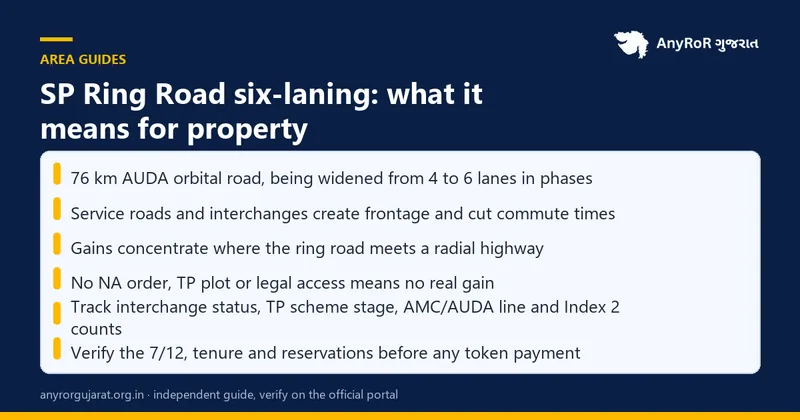
The Sardar Patel Ring Road is the 76 km orbital road around Ahmedabad built by AUDA in the 2000s. AUDA's project to widen it from four to six lanes, with service roads and new grade separators at the busiest junctions, is under way in phases and is the single largest driver of land prices on the city's fringe. The belts that gain most are those where the ring road meets a radial highway: Sarkhej and Shela in the south-west, Vaishnodevi and Zundal in the north, Jagatpur–Tragad in the north-west, and the Sanand side. Wider roads raise prices only where NA conversion, TP schemes and utilities follow; a plot beside the ring road with no approved layout is still farmland. Track the interchanges, the TP scheme status and the AMC/AUDA line, and verify every plot's record before you invest.
Every Ahmedabad developer's brochure since 2010 has mentioned the SP Ring Road, and every fringe farmer has priced their land against it. The six-laning has turned that into a fresh cycle of expectation: hoardings at Sanathal, township launches at Jagatpur, plotted schemes at Chharodi. Some of it is justified. This guide explains what the ring road is and what the six-lane project involves, why a wider road moves prices and where it does not, which belts stand to benefit and why, the commercial side that residential coverage skips, what to track instead of watching prices, a simple way to evaluate any ring-road locality, and the risks that a land-record check catches before a cheque is written.
What the SP Ring Road is
- Length and shape: about 76 km, circling the city roughly 6 to 8 km outside the old municipal limits, crossing every radial: the Sarkhej–Gandhinagar (SG) Highway twice (Sarkhej in the south-west and Vaishnodevi in the north), the Sanand road, the Mehsana–Kalol road, the Gandhinagar road at Zundal, the Narol–Aslali NH corridor, and the Mumbai and Rajkot highways.
- Owner: the Ahmedabad Urban Development Authority (AUDA), which built it as a toll-free four-lane road in the mid-2000s to divert through-traffic and open land for development.
- Role today: the boundary between "city" and "fringe" in buyers' minds, the route trucks take around Ahmedabad, and the spine along which AUDA has drawn most of its recent TP schemes.
The six-lane project
| Element | What is planned or under way |
|---|---|
| Carriageway | Widening from 4 lanes to 6 lanes along the full loop, in phases by stretch |
| Service roads | Parallel service lanes on both sides in built-up stretches, so local traffic and property access stay off the main carriageway |
| Junctions | Flyovers, underpasses or interchanges at the busiest crossings (the SG Highway junctions at Sarkhej and Vaishnodevi, Sanand, Zundal and the eastern highway crossings among them) |
| Drainage and lighting | Storm-water drains, street lighting and pedestrian crossings in urbanised stretches |
| Cost and timeline | Reported in the region of ₹2,000 crore for the widening programme, executed in stretches over several years; individual sections open as they finish |
Because the work is phased, "the ring road is being six-laned" means different things at Shela (largely done or in progress) and at a rural eastern stretch (planned). Ask AUDA's project office, or simply drive the stretch, before you believe a brochure's timeline.
Why a wider road moves property prices
- Time, not distance. A six-lane road with interchanges cuts the peak-hour time from Shela to SG Highway or from Jagatpur to the airport by minutes that matter to a daily commuter, and buyers pay for minutes.
- Trucks off the local roads. Grade separators keep through-traffic moving, which makes the adjoining localities quieter and safer, and lifts residential demand.
- Service roads create frontage. Plots that could not be accessed safely from a four-lane highway become commercial frontage once a service road exists; that is where showrooms, hotels and warehouses go.
- TP schemes follow. AUDA draws Town Planning schemes along the corridor, which regularise plots, provide internal roads and reserve land for amenities. A finalised TP scheme is what turns a field into a saleable layout.
- Expectation. Some of the price rise is simply the market pricing in the future. That part can reverse if the timeline slips.
Where the road does not move prices
- Where the land is still agricultural and the owner cannot get NA permission because the Development Plan zone does not allow the intended use.
- Where a plot has road frontage on paper but no legal access because the service road is not built or the plot is landlocked behind another survey number.
- Where the parcel is new-tenure land or tribal-restricted land that cannot be transferred (see the tenure guide).
- Where the stretch carries reservations for widening, drains or utilities that take a strip off the front of the plot.
- In pockets between interchanges with no exit; a ring road you cannot get onto is just noise.
Belts that stand to benefit
| Belt | Interchange | What is happening | Buyer type |
|---|---|---|---|
| Shela, Ghuma, Sanathal, Shantipura | Sarkhej (SG Highway south) and the Bopal–Ghuma link | Townships, plotted bungalow schemes, schools | Families from Bopal; plot buyers; see the South Bopal guide |
| Vaishnodevi, Zundal, Khoraj | Vaishnodevi (SG Highway north) and the Gandhinagar road | Large gated townships, GIFT-facing demand, metro phase 2 nearby | Gandhinagar and GIFT commuters; investors |
| Jagatpur, Tragad, Chharodi, Chenpur | The north-west arc between SG Highway and the Kalol road | Dense 2–3 BHK supply spilling over from Gota; see the Gota guide | First-time buyers |
| Sanand corridor | Sanand road interchange | Industrial employment, mid-market housing, warehousing | Sanand plant employees; logistics investors |
| Eastern arc (Narol, Aslali, Vastral–Nikol edge) | NH crossings and the Odhav side | Logistics parks, affordable housing, industrial plots | Warehouse and affordable-housing investors |
The commercial side
Residential coverage of the ring road misses the larger economic effect: service roads and interchanges create warehouse, showroom and hospitality land. Logistics operators want ring-road frontage near the NH crossings on the east and the Sanand side; car dealers, hotels and wedding venues want the SG Highway junctions and the Sanathal–Shela stretch. Commercial plots are valued and stamp-dutied on commercial Jantri, which is far above residential in the same zone, and they need NA permission for the specific commercial or industrial use. A residential plot bought in expectation of a commercial future needs a fresh NA order to realise it.
What to track instead of prices
- Interchange status: which grade separators are tendered, under construction or open; AUDA's notices and site visits.
- TP scheme stage: draft, sanctioned, preliminary or final. Final plots with a number and a Property Card are bankable; draft-stage land is a bet on AUDA's timetable.
- Development Plan zone: residential, commercial, industrial or agricultural. This decides whether NA permission can be granted at all.
- AMC/AUDA boundary: merged villages get municipal water, drainage and property tax; AUDA areas run on different arrangements.
- Utilities: piped water, drainage lines and GETCO power along the stretch.
- Registrations: the count and value of Index 2 entries in the village over the last 2 years on gARVI, which is the real demand signal.
A simple way to evaluate any ring-road locality
- Access: how many minutes from the plot to an interchange, and is there a service road today?
- Paper: NA order for the intended use, final TP plot number or a Property Card, old tenure, no pending entries. See the NA guide and the rural land record guide.
- Services: water, drainage, power and a maintained internal road.
- Demand: Index 2 registrations, occupancy of completed towers, school and shop openings.
- Price versus Jantri: the gap between the asking price and the zone's Jantri; a huge premium over Jantri with none of the above in place is speculation, and stamp duty will be on the higher figure anyway (see the Ahmedabad Jantri guide).
Risks to check before you invest
| Risk | How it shows up | What protects you |
|---|---|---|
| Agricultural land sold as "NA plot" | 7/12 still shows agricultural tenure; "NA applied" | Insist on the NA order and the approved layout; non-agriculturists may not be able to buy at all |
| New tenure or tribal land | Tenure line on the 7/12; VF-6 grant entry | Premium order converting to old tenure; 73AA sanction where applicable |
| Road-widening or drain reservation | Development Plan and TP scheme drawings | Part-plan and zoning certificate from AUDA before buying |
| Landlocked plot | No road on the village map or FMS | Registered right of way or a plot on an approved layout road |
| Multiple sales of the same plot | Index 2 shows more than one buyer | Index 2 search by survey number before the token |
| Pending mutation or 135-D dispute | e-Chavdi and VF-6 status | Wait for certification; see the e-Chavdi guide |
| Project delays | RERA quarterly progress flat for a year | RERA checks; see the GujRERA guide |
| Timeline slippage on the road itself | Interchange still at tender stage | Buy for use, not for a date |
Frequently asked questions (વારંવાર પૂછાતા પ્રશ્નો)
What is the SP Ring Road in Ahmedabad?
The Sardar Patel Ring Road is AUDA's 76 km orbital road around Ahmedabad, built in the 2000s as a four-lane toll-free road that crosses every radial highway and marks the edge of the city's development belts.
Is the SP Ring Road being widened to six lanes?
Yes. AUDA is widening the loop to six lanes in phases, with service roads and grade separators at major junctions. Stretches open as they are completed; check the status of the specific stretch you care about.
Which areas benefit most from the SP Ring Road expansion?
The belts at its interchanges with radial highways: Shela–Sanathal–Shantipura at the Sarkhej end, Vaishnodevi–Zundal in the north, Jagatpur–Tragad–Chharodi on the north-west arc, the Sanand corridor and the eastern NH crossings for logistics.
Will property prices rise along the SP Ring Road?
They tend to where interchanges, service roads, TP schemes and utilities arrive together. Land without NA permission, legal access or a final TP plot does not gain in the same way, and part of the current price already reflects expectation.
Is it safe to buy a plot near the SP Ring Road?
Only with the paperwork: NA order for the intended use, approved layout or final TP plot, old tenure, no pending entries, legal road access, and a zoning certificate showing no reservation. The land record on AnyRoR and the Index 2 on gARVI are the first checks.
Can a non-farmer buy land near the ring road?
Only NA land. Agricultural land in Gujarat can generally be bought only by agriculturists, so a "future NA" plot is not available to most investors until the NA order exists.
What is the difference between AMC and AUDA areas on the ring road?
Villages merged into AMC receive municipal water, drainage and property tax; AUDA areas are administered by the development authority with different service and permission arrangements. The boundary affects both daily life and paperwork.
Is commercial land near the ring road a good investment?
Service-road frontage near interchanges attracts warehouses, showrooms and hotels, but the plot needs NA permission for that specific use and is valued and taxed on commercial Jantri. Verify the Development Plan zone first.
How do I check if a ring-road plot has a reservation on it?
Obtain the part-plan and zoning certificate from AUDA or the town planning office for the survey number; it shows road-widening lines, drains and other reservations from the Development Plan and TP scheme.
What is the best signal of real demand in a ring-road belt?
Registered transactions. Count and read the Index 2 entries for the village over the last 2 years on gARVI; they show actual buyers and prices, unlike listings and hoardings.