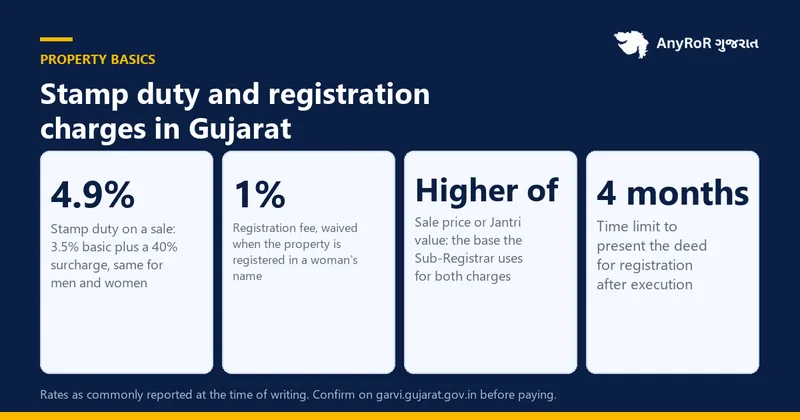
Stamp duty on a sale of property in Gujarat is 4.9% of the value (3.5% basic duty plus a 40% surcharge), and the registration fee is 1%. Both are charged on the sale price or the Jantri value, whichever is higher. Gujarat waives the 1% registration fee when the property is registered in a woman's name, but the stamp duty is the same for everyone. Pay online through e-stamping or the gARVI portal, then register the deed at the Sub-Registrar office within 4 months of execution.
The two government charges on a property deal are the ones buyers most often under-budget, partly because brokers quote the price "all inclusive" and partly because the duty is not calculated on the price you negotiated but on the higher of that price and the Jantri value. On a ₹50 lakh flat the combined bill is close to ₹3 lakh, and it is due before the Sub-Registrar will touch your deed.
This guide sets out the current rates, the formula, worked examples for a flat and for farmland, the deeds other than sale that attract duty, the women's concession and how to claim it, the online payment steps, the documents the Sub-Registrar asks for, the refund process for a cancelled deal, and the mistakes that cost people money. Rates are set by government notification and do change; every figure here is as commonly reported at the time of writing, and you should confirm the live figure on garvi.gujarat.gov.in before you pay.
The current rates at a glance
| Charge | Rate | Charged on |
|---|---|---|
| Basic stamp duty | 3.5% | Sale price or Jantri value, whichever is higher |
| Surcharge (40% of basic duty) | 1.4% | Same base |
| Total stamp duty | 4.9% | Same base; same for men and women |
| Registration fee | 1% | Same base; nil if registered in a woman's name (sole or joint with only women) |
| Other charges | Small fixed amounts | Scanning, copying, e-stamp service charge |
Together that is 5.9% for a male buyer and 4.9% for a female buyer. The difference is exactly the registration fee, which is why so many Gujarat families register the home in the wife's or daughter's name.
How the base value is decided: price versus Jantri
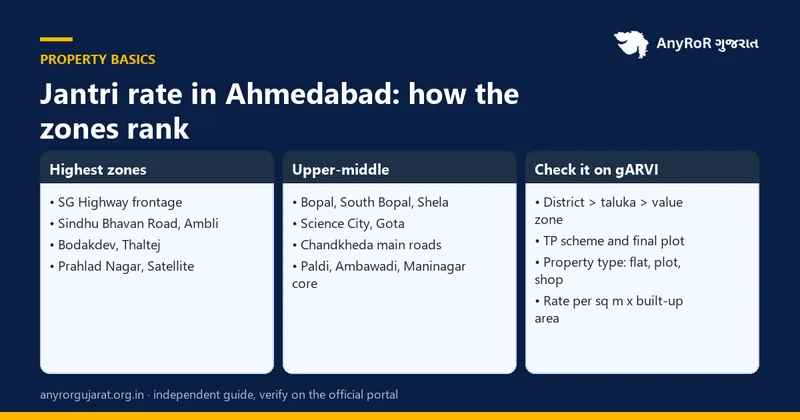
Jantri (જંત્રી) is the Annual Statement of Rates, the government's minimum value per square metre for every village and city zone. The Sub-Registrar's software computes the Jantri value of your property from its area, location and type, compares it with the consideration in the deed, and charges duty on the higher figure. Declaring a lower price does not lower the duty; it only creates an income-tax problem for both sides. Our Jantri guide shows how to look up the rate before you negotiate.
Worked example 1: a flat in Ahmedabad
| Item | Registered in a man's name | Registered in a woman's name |
|---|---|---|
| Agreed price | ₹50,00,000 | ₹50,00,000 |
| Jantri value (rate × carpet area, with floor and age factors) | ₹46,00,000 | ₹46,00,000 |
| Base for duty (higher of the two) | ₹50,00,000 | ₹50,00,000 |
| Stamp duty at 4.9% | ₹2,45,000 | ₹2,45,000 |
| Registration fee at 1% | ₹50,000 | ₹0 |
| Total | ₹2,95,000 | ₹2,45,000 |
Worked example 2: agricultural land where Jantri is higher
A buyer agrees ₹18 lakh for 0-80-00 hectares (8,000 sq m) of farmland. The Jantri rate for that village is ₹300 per sq m, so the Jantri value is ₹24 lakh. Duty is charged on ₹24 lakh: stamp duty ₹1,17,600 and registration fee ₹24,000, a total of ₹1,41,600 even though the buyer is paying ₹18 lakh. This happens often after the 2023 doubling of Jantri rates in areas where market prices did not keep pace. Check the rate on the 7/12's area figure before you sign the agreement.
Stamp duty on deeds other than a sale
| Document | Typical duty position in Gujarat |
|---|---|
| Sale deed / conveyance | 4.9% plus 1% registration |
| Gift deed to a family member (spouse, children, parents, siblings, grandchildren) | Concessional fixed duty, far below the sale rate; registration fee still applies unless the donee is a woman |
| Gift deed to a non-relative | Treated like a sale on Jantri value |
| Agreement to sell with possession | Duty as on a conveyance; adjusted against the final sale deed |
| Lease deed | Duty on a percentage of average annual rent, rising with the lease term |
| Mortgage deed (housing loan) | Low percentage of the loan amount, subject to a cap |
| Power of attorney for sale to a non-relative | Duty as on a conveyance |
| Partition deed among family | Fixed or low duty on the separated shares |
| Release / relinquishment deed among heirs | Concessional duty when within the family |
The exact figures for these instruments are set out in Schedule I of the Gujarat Stamp Act and change by notification. Ask the Sub-Registrar office or use the gARVI fee calculator for the precise amount on your document.
The women's concession: how to qualify
- The registration fee waiver applies when the buyer named in the deed is a woman, or all buyers are women. A joint deed with a husband and wife pays the fee on the whole value; a deed in the wife's name alone pays none.
- Stamp duty itself is not reduced for women in Gujarat, unlike some states that cut 1% to 2% for female buyers.
- Home-loan banks are comfortable with a property in the wife's name if she is a co-borrower or the husband is a guarantor; agree this with the bank before drafting the deed.
- Ownership follows the deed. A property registered in a woman's name is legally hers; families should treat the saving as a real transfer, not a paperwork trick.
How to pay stamp duty online in Gujarat
Step 1 — Compute the duty
On gARVI use the fee calculator (or the Jantri lookup plus the rates above). Your advocate or the document writer will confirm the figure; the Sub-Registrar's system does the final computation at registration.
Step 2 — Buy e-stamp or pay through the portal
Gujarat uses e-stamping through authorised collection centres and banks, and online payment through the registration portal for the duty and fee. You receive an e-stamp certificate or a payment receipt with a unique number that is printed on or attached to the deed.
Step 3 — Book a registration slot
Registration in Gujarat is by online appointment at the jurisdictional Sub-Registrar office. Upload the draft deed and party details, choose a date and time, and note the token.
Step 4 — Appear with the parties and witnesses
Buyer, seller and 2 witnesses attend with originals. Photographs, thumb impressions and biometric verification are taken, the deed is signed before the Sub-Registrar and the document is scanned.
Step 5 — Collect the registered deed and Index 2
The registered deed is returned (often the same day or within a few days) and the transaction appears in the Index 2 register. Pull the Index 2 as your proof, then apply for mutation so the land record catches up.
Documents the Sub-Registrar will ask for
- The deed, drafted on the correct stamp value, with the e-stamp certificate or payment receipt.
- Identity and address proof of buyer, seller and witnesses (Aadhaar, PAN; PAN is compulsory above ₹10 lakh).
- Latest 7/12 and 8A for farmland, or Property Card for urban property, plus the previous title deed.
- Approved plan and building use permission for a flat; society NOC where required.
- No-dues certificates for property tax and, if applicable, the bank's release of an earlier mortgage.
- For new-tenure land or land under special Acts, the Collector's permission.
- Passport-size photographs and the TDS challan if the price exceeds ₹50 lakh (1% TDS by the buyer).
Refund of stamp duty on a cancelled deal
If the transaction falls through after you bought the e-stamp but before the deed was executed, or the deed is cancelled for a permitted reason, you can apply to the Collector of Stamps for a refund. The application must be made within the period allowed under the Act (generally 6 months from purchase of the stamp), with the original stamp, an affidavit stating why it was not used, and the cancellation document where one exists. A deduction is made from the amount refunded. Refunds are not available merely because you changed your mind after registration.
Penalties for under-stamping and late registration
- Under-valuation: the Sub-Registrar can refer the document to the Deputy Collector (Stamp Duty Valuation), who can demand the deficit with a penalty that can be several times the shortfall.
- Late registration: a document must be presented within 4 months of execution; a further 4 months is possible with a fine of up to 10 times the registration fee.
- Unregistered sale: an unregistered sale agreement does not transfer title and is inadmissible as evidence of the sale, whatever the stamp paid.
Mistakes that cost buyers money
- Budgeting duty on the agreed price without checking the Jantri value.
- Registering jointly in husband's and wife's names and losing the 1% waiver that a wife-only deed would have earned.
- Paying "stamp duty" in cash to an intermediary instead of buying an e-stamp in the buyer's own name.
- Using the wrong instrument, for example a gift deed to a friend expecting the family concession.
- Forgetting TDS on deals above ₹50 lakh and then paying interest on it.
- Treating registration as the finish line and never applying for mutation, so the 7/12 or Property Card still shows the seller years later.
Frequently asked questions (વારંવાર પૂછાતા પ્રશ્નો)
What is the stamp duty rate in Gujarat in 2026?
Stamp duty on a sale is 4.9% of the property value (3.5% basic plus a 40% surcharge), and the registration fee is 1%. Both are computed on the higher of the sale price and the Jantri value. Confirm the current figures on garvi.gujarat.gov.in, because rates are changed by notification.
Is stamp duty lower for women in Gujarat?
The stamp duty rate is the same, but the 1% registration fee is waived when the property is registered in a woman's name alone or in the names of women only. That saving is ₹50,000 on a ₹50 lakh property.
How is stamp duty calculated on a flat in Gujarat?
Multiply the higher of the agreed price and the Jantri value by 4.9% for stamp duty, and by 1% for the registration fee (nil for a woman buyer). For a ₹50 lakh flat that is ₹2,45,000 plus ₹50,000.
Who pays stamp duty, the buyer or the seller?
By custom and under most agreements in Gujarat the buyer pays both stamp duty and the registration fee. The parties may agree otherwise in the deed, but the liability to the government must be discharged before registration either way.
Can I pay Gujarat stamp duty online?
Yes. Buy an e-stamp through an authorised centre or bank, or pay the duty and fee online through the registration portal, then book a registration appointment at the Sub-Registrar office and attend with the parties and witnesses.
What is the stamp duty on a gift deed in Gujarat?
Gifts to close family members attract a concessional fixed duty that is far lower than the 4.9% sale rate; gifts to non-relatives are charged like a sale on the Jantri value. The registration fee applies unless the recipient is a woman.
What happens if I pay less stamp duty than required?
The document can be impounded and referred for valuation. You will have to pay the deficit plus a penalty that can be a multiple of the shortfall, and the deed cannot be relied on in court until the duty is made good.
Is stamp duty refundable if the sale is cancelled?
Partly, and only in defined situations. Apply to the Collector of Stamps within the time limit with the unused or cancelled stamp and an affidavit; a deduction is made from the refund. Duty on a completed, registered sale is not refunded.
Do I pay stamp duty again when I take a home loan?
The loan itself attracts a separate, much smaller duty on the mortgage deed or memorandum of deposit of title deeds, usually a fraction of a percent of the loan with a cap. The bank normally arranges it and adds it to the loan costs.
Is the 1% registration fee waived for a joint husband-and-wife purchase?
No. The waiver applies when every buyer named in the deed is a woman. A joint deed with a male co-owner pays the full 1%.