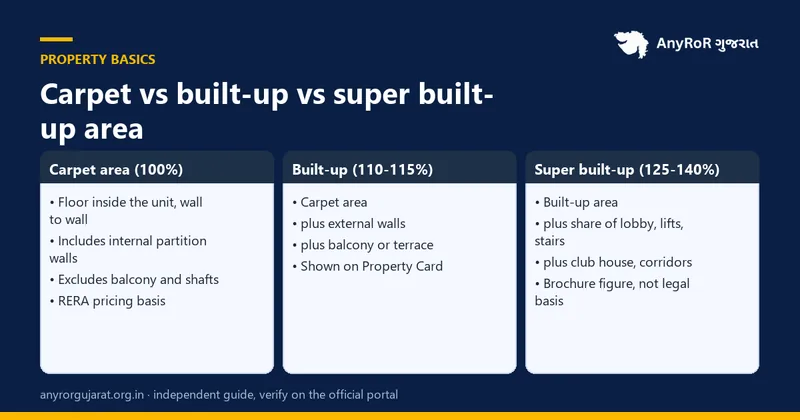
Carpet area is the floor you can actually walk on inside your unit. Built-up area adds the walls and balconies, typically 10% to 15% more. Super built-up area adds your share of lobbies, lifts, staircases and amenities, usually 25% to 40% more than carpet. Under RERA a Gujarat builder must quote the price on carpet area, so a "1,200 sq ft flat" sold on super built-up may give you only about 850 to 900 sq ft of usable floor. Always ask for the RERA carpet area in writing and compute your price per square foot on that.
Two flats advertised at 1,200 square feet can differ by a whole bedroom, because one number is carpet area and the other is super built-up. The gap is not fraud in itself: every flat really does share lobbies and lifts. The problem is that the three measures get used interchangeably in brochures, bank valuations, society records and Jantri calculations, and the buyer ends up comparing prices that are not comparable.
This guide defines each measure the way the RERA Act and Gujarat's practice define it, shows the formulas and the loading factor, works through a real Ahmedabad example, explains which area appears on the Property Card, the sale deed, the property tax bill and the Jantri calculation, and gives you a 4-question script to use with any builder or broker.
The 3 measures, defined
Before 2017 there was no legal definition and builders chose their own. The RERA Act fixed carpet area as "the net usable floor area of an apartment, excluding the area covered by the external walls, areas under services shafts, exclusive balcony or verandah area and exclusive open terrace area, but includes the area covered by the internal partition walls". That is now the only measure a price can lawfully be quoted on for a new project in Gujarat. See our GujRERA guide for how to verify it on the portal.
Side-by-side comparison
| Carpet | Built-up | Super built-up | |
|---|---|---|---|
| Includes rooms, kitchen, bathrooms, passages | Yes | Yes | Yes |
| Internal partition walls | Yes (RERA) | Yes | Yes |
| External walls | No | Yes | Yes |
| Balcony / terrace of the unit | No (shown separately) | Yes | Yes |
| Lobby, lift, staircase, corridors | No | No | Proportionate share |
| Club house, gym, garden | No | No | Often included |
| Legal basis for pricing a new flat | Yes, under RERA | No | No |
| Typical size relative to carpet | 100% | 110–115% | 125–140% |
The loading factor: the number that explains the gap
Builders convert carpet area to super built-up area with a loading factor:
Super built-up area = Carpet area × (1 + loading)
A loading of 0.30 (30%) turns 900 sq ft of carpet into 1,170 sq ft of super built-up. Loading of 20% to 25% is common in older low-rise societies with few amenities; 30% to 40% is common in new high-rise projects with double-height lobbies, club houses and multiple lifts. Two flats with the same super built-up area but different loading can differ by 100 sq ft of usable space.
To reverse the calculation when you only have the super built-up figure:
Carpet area ≈ Super built-up area ÷ (1 + loading)
If the builder will not tell you the loading, the approved plan on GujRERA will: it lists the carpet area of every unit.
Worked example: a 2 BHK in Ahmedabad
| Measure | Area | Price at ₹6,000 per sq ft "quoted" | Effective price per sq ft of carpet |
|---|---|---|---|
| Carpet area (RERA) | 880 sq ft | ₹52.8 lakh | ₹6,000 |
| Built-up area (+12%) | 986 sq ft | ₹59.2 lakh | ₹6,720 |
| Super built-up area (+32% loading) | 1,162 sq ft | ₹69.7 lakh | ₹7,920 |
Same flat, same headline rate, a ₹17 lakh difference depending on which area the rate is multiplied by. When a broker says "₹6,000 a foot", the only sensible follow-up is "on which area?"
Which area appears on which document
| Document | Area shown | Why it matters |
|---|---|---|
| Builder brochure | Often super built-up, sometimes both | Marketing; not binding unless in the agreement |
| RERA project page and approved plan | Carpet area per unit | The legally binding figure for a new project |
| Agreement for sale and sale deed | Carpet area (RERA projects); older deeds may show built-up | Determines the price and future resale description |
| Property Card / Unit Property Card | Built-up area of the unit as recorded by the City Survey Office | Used for Jantri value and municipal records |
| Jantri valuation for stamp duty | Built-up area per the ASR rules, with floor and age factors | Drives the stamp duty you pay |
| Municipal property tax bill | Carpet area (AMC formula uses carpet area in sq m) | Drives your annual tax; see the AMC property tax guide |
| Bank valuation report | Usually built-up or carpet, valuer's choice | Affects loan amount |
Because each document uses a different measure, the same flat can legitimately show 880, 986 and 1,162 sq ft in three places. Keep a note of which is which; it avoids arguments at resale.
Plinth area, covered area and saleable area
- Plinth area is the built-up area measured at floor level including external walls; engineers use it for construction cost. For a flat it is close to built-up area.
- Covered area is a loose term for built-up area in older documents.
- Saleable area is another name for super built-up area, used in commercial property and some society records.
- Usable area in bank valuations generally means carpet area.
How to measure carpet area yourself
- Measure each room, kitchen, bathroom and internal passage wall-to-wall (inside face of the walls) with a laser measure, in metres.
- Multiply length by width for each space and add them up. Include the area under internal partition walls if you want the RERA figure (the approved plan already does).
- Exclude the balcony, any open terrace, and duct or shaft areas.
- Convert to square feet by multiplying square metres by 10.764.
- Compare with the carpet area in the agreement. RERA allows a small variation; anything beyond it entitles you to a proportionate refund.
Four questions to ask any builder or broker
- "What is the RERA carpet area of this exact unit, and where is it in the approved plan?"
- "What is the loading factor, and what is included in it?"
- "Is the balcony area shown separately in the agreement?"
- "What is the price per square foot on carpet area?"
If the answers are vague, the GujRERA project page will have the plan; open it before you pay a token.
Frequently asked questions (વારંવાર પૂછાતા પ્રશ્નો)
What is the difference between carpet area and built-up area?
Carpet area is the usable floor inside the unit, wall to wall. Built-up area adds the thickness of the external walls and the unit's balcony or terrace, so it is usually 10% to 15% larger than carpet area.
What is super built-up area?
Built-up area plus a proportionate share of the building's common areas such as lobbies, staircases, lifts and amenities. It is typically 25% to 40% larger than carpet area, depending on the loading factor.
Is it legal to sell a flat on super built-up area in Gujarat?
For a RERA-registered project, the price must be quoted on carpet area. Builders may still mention super built-up area for information, but the agreement for sale has to state the carpet area and the price on it.
How do I convert super built-up area to carpet area?
Divide the super built-up area by 1 plus the loading factor. With a 30% loading, 1,300 sq ft super built-up is about 1,000 sq ft carpet. If the loading is unknown, the carpet area is in the approved plan on the GujRERA project page.
Does carpet area include the balcony?
No. Under the RERA definition the exclusive balcony or verandah area is excluded from carpet area and must be shown separately. It is included in built-up and super built-up area.
Which area is used for Jantri and stamp duty in Gujarat?
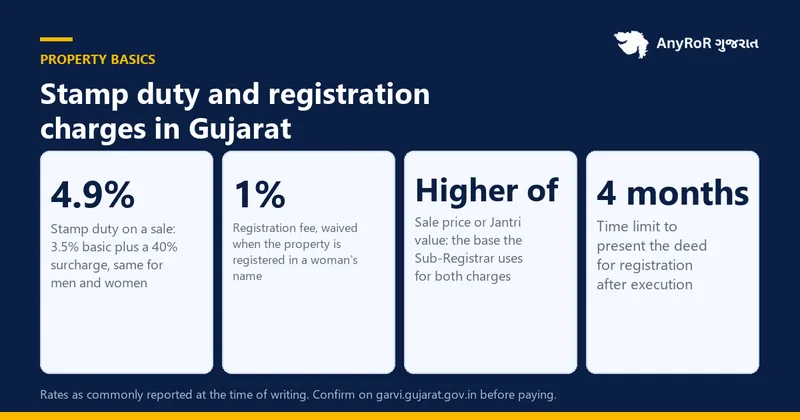
The Annual Statement of Rates applies its per-square-metre rate to the built-up area of a flat, with adjustments for floor level and building age, and the Sub-Registrar uses the higher of that value and the sale price to charge stamp duty.
Which area is used for property tax in Ahmedabad?
The Ahmedabad Municipal Corporation formula is based on carpet area in square metres, multiplied by a base rate and factors for location, age, use and occupancy.
What is a normal loading factor?
Roughly 20% to 25% in older low-rise societies and 30% to 40% in new high-rise projects with large lobbies and amenities. Anything above 40% deserves a question about what exactly is being loaded.
Can I claim a refund if the carpet area is less than promised?
Yes. RERA requires the promoter to refund the excess price proportionately if the final carpet area is smaller than in the agreement beyond the permitted tolerance, and to charge only for a limited increase if it is larger.