A 7/12 Utara (સાત બાર ઉતારો) is 2 village forms printed together: Village Form 7 shows who owns a survey number, its area, tenure and encumbrances, and Village Form 12 shows what was grown on it each season. Read the owner's name, the tenure line, the "Boja" (encumbrance) column and the latest mutation entry number first; those 4 items tell you whether the land can be sold and whether anyone else has a claim on it.
Most people open a 7/12 Utara for the first time when they are about to buy farmland, inherit a family plot or apply for a crop loan. The document is only 1 or 2 pages, but it is written in revenue-department Gujarati with abbreviations that nobody explains. This guide walks through every column in the order it appears on the printout from anyror.gujarat.gov.in, says what each one means in plain English, and points out the entries that should stop a deal until they are cleared up.
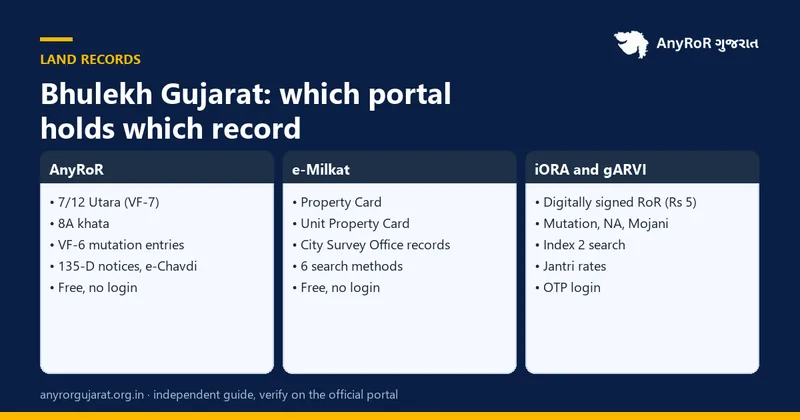
If you have not downloaded the record yet, follow our rural land record guide first. It shows the exact clicks on the AnyRoR portal. Come back here with the PDF or the screen open.
What the numbers 7 and 12 mean
Gujarat keeps village land records in a set of numbered registers called Village Forms (ગામ નમૂના). Two of them matter for an individual plot:
- Village Form 7 (ગામ નમૂનો ૭) is the ownership and rights register for a single survey number. It records the holder, the area, the type of tenure, the land revenue assessment and any burdens on the land.
- Village Form 12 (ગામ નમૂનો ૧૨) is the crop register (પાક નોંધ). For each season it records which crop was sown, on how much area, and whether it was irrigated.
Because the two forms are always printed on one sheet, the printout is called "7/12". "Utara" (ઉતારો) simply means an extract or copy. So a 7/12 Utara is an extract of Forms 7 and 12 for one survey number. Two related forms are worth knowing: Village Form 8A lists every survey number held by one account holder (ખાતેદાર), and Village Form 6 is the mutation register (હક પત્રક) where every change of rights is entered before it reaches Form 7.
The header: village, survey number and block number
The top of the record identifies the land. Check each item against the sale agreement or the family papers you were given.
| Field on the record | Gujarati label | What to check |
|---|---|---|
| District, taluka, village | જિલ્લો, તાલુકો, ગામ | Must match the location in the deed. Villages with the same name exist in different talukas. |
| Survey number | સર્વે નંબર | The original plot number from the land survey. Sub-divided plots carry a slash, for example 145/2. |
| Block number | બ્લોક નંબર | Issued after consolidation (એકત્રીકરણ). In many villages the block number, not the survey number, is the working identifier today. |
| UPIN | યુપીઆઈએન | A unique property identification number added by the state. Handy for searching the urban portal; not every rural record shows one yet. |
If the survey number on the record and the number in the sale agreement differ, stop and ask why. A common honest reason is that the agreement quotes the old survey number and the record shows the new block number. A less honest reason is that you are being shown the record of a neighbouring plot.
Area, assessment and tenure (the Form 7 top block)
Area (ક્ષેત્રફળ)
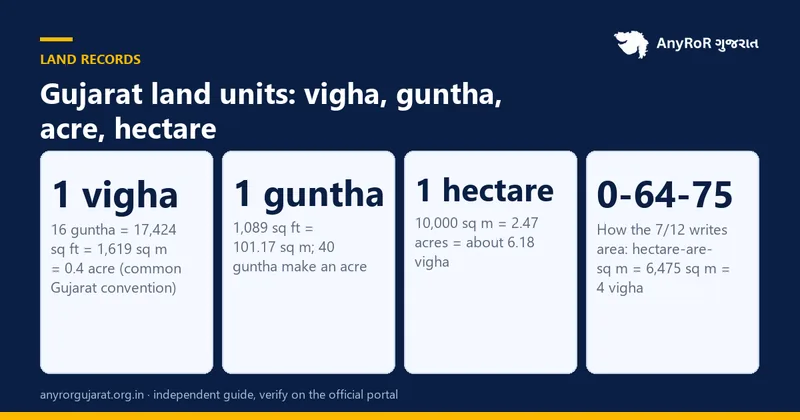
Area is written in hectare-are-square metre form, for example 0-64-75, which is 0 hectares, 64 ares and 75 square metres, or 6,475 square metres. One are is 100 square metres and one hectare is 10,000 square metres. Older documents and most farmers still talk in bighas and vighas; the conversion varies by district, so rely on the metric figure when you compare with the deed.
Some records split the area into cultivable (ખેડાણ લાયક) and non-cultivable (પોત ખરાબો) portions. Pot kharabo is land inside the survey number that cannot be farmed, such as a rocky patch, a path or a water channel. You pay for it, but you cannot grow on it.
Assessment (આકાર)
Aakar is the annual land revenue fixed for the plot, shown in rupees and paise. The amounts are tiny by today's standards and are rarely relevant to a buyer, but the presence of an assessment confirms the land is recorded as agricultural.
Tenure (જમીનનો પ્રકાર / સત્તા પ્રકાર)
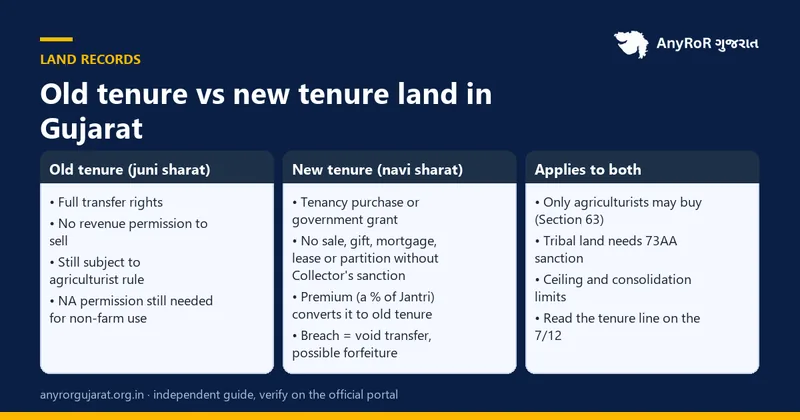
This is the single most important line for anyone planning to buy or build. Gujarat land falls broadly into 2 tenures:
- Old tenure (જૂની શરત): the holder has full rights. The land can be sold to another agriculturist without special permission, subject to the usual agricultural land laws.
- New tenure (નવી શરત) or restricted tenure (પ્રતિબંધિત સત્તા પ્રકાર): the land was granted by the government, often to a landless or tenant farmer, with conditions attached. It generally cannot be sold, gifted, mortgaged or converted to non-agricultural use without the Collector's permission and payment of a premium. Look for words like નવી શરત, ગણોત (tenancy) or પ્રતિબંધિત.
New-tenure land is not impossible to buy, but the process, cost and time are completely different. Any seller who says "it is just a formality" should be asked to obtain the permission first.
The occupant and holder columns
Form 7 names the person who holds the land in the Khatedar or occupant column (કબજેદારનું નામ / ખાતેદારનું નામ), along with the account number (ખાતા નંબર). Several names can appear together when land is held jointly, for example by brothers after an inheritance. Each name usually carries the mutation entry number (નોંધ નંબર) through which it was added, printed in brackets.
Three things to verify here:
- The seller is actually listed. A power of attorney holder, a tenant or a relative "managing" the land is not the owner. Only the names in this column can transfer the land.
- All joint holders are on the agreement. If 4 names appear and only 1 person is signing, you are buying a share, not the plot.
- Spelling matches the Aadhaar and the deed. Minor spelling differences are common and fixable, but they delay registration and mutation, so sort them out before you pay.
Other rights and encumbrances (બીજા હક્ક અને બોજા)
This column is where trouble hides. Anything written here is a claim on the land by someone other than the holder. Typical entries:
| Entry you may see | Meaning | What it means for a buyer |
|---|---|---|
| Bank name with a loan amount (બોજો) | A crop loan or mortgage is registered against the land. | The bank must issue a no-dues letter and the charge must be removed by a fresh mutation before the sale is clean. |
| Ganotiya / tenant name (ગણોતિયો) | A protected tenant cultivates the land. | Tenants have statutory rights. Take legal advice; do not rely on the seller's word. |
| Court case or stay (કોર્ટ કેસ / મનાઈ હુકમ) | Litigation is pending, or a court has restrained transfers. | Wait for the case to end or walk away. |
| Government acquisition note (સંપાદન) | All or part of the land is notified for acquisition. | You may be buying land you cannot keep. Check the notification. |
| Well, tree or path rights (કૂવો, ઝાડ, રસ્તો) | A neighbour has a recorded right to use a well or path on the plot. | Not a deal-breaker, but it stays with the land. |
An empty encumbrance column is good news, but it is not proof. Charges are sometimes recorded late. For a purchase of any size, also pull the Index 2 from the registration portal, which shows registered transactions the village record may not have caught up with yet.
Mutation entries and 135-D notices
Every change to Form 7, whether a sale, an inheritance, a loan or a court order, first becomes a numbered entry in Village Form 6 (હક પત્રક). The entry number is quoted on the 7/12 next to the change it caused. Two states of an entry matter:
- Certified (પ્રમાણિત): the entry was checked by the revenue officer and has taken effect.
- Pending or under objection (પડતર / વાંધા હેઠળ): a 135-D notice has been issued to interested parties and the objection period is running. The change is not final.
A pending entry is a flag, not necessarily a problem. It could be the seller's own inheritance entry that is a few weeks from certification. But you should know what it is. You can read every entry by choosing Mutation Entry Details or 135-D Notice Details on the rural land record page, and you can watch new notices for a whole village through e-Chavdi. Our mutation guide explains the full life cycle of an entry.
Form 12: the crop register
The lower half of the printout is Village Form 12. Each row is one season (ઋતુ) in one year:
- Year and season: kharif (ખરીફ, monsoon), rabi (રવી, winter) or summer (ઉનાળુ).
- Crop name and area: for example groundnut on 0-50-00 and cotton on 0-14-75.
- Irrigated or unirrigated (પિયત / બિન પિયત) and the source, such as a well or canal.
- Cultivator (ખેડનારનું નામ): normally the holder. A different name every season points to an informal tenancy.
- Fallow (પડતર): the land was not sown.
Buyers often skip Form 12, but it answers 2 practical questions: is there water, and is somebody else farming the land? Banks read it for crop-loan eligibility, and it is the evidence used when crop insurance or compensation is calculated.
A 5-minute checklist before you rely on a 7/12
- Download the record yourself from the portal on the day you check it. Do not accept a photocopy as proof of the current position.
- Match district, taluka, village, survey and block number with the deed.
- Confirm the seller's name and khata number are in the holder column and that every joint holder is party to the agreement.
- Read the tenure line. Old tenure is straightforward; new tenure needs permission before anything else happens.
- Read every word in the other rights and encumbrance column. Get bank charges released before you pay the balance.
- Look for pending mutation entries and open 135-D notices.
- Cross-check with Index 2 and, for urban plots, the Property Card.
- For any transaction, pay ₹5 for a digitally signed copy from iORA. It carries a verifiable signature and banks and sub-registrars accept it.
Frequently asked questions (વારંવાર પૂછાતા પ્રશ્નો)
Is a 7/12 Utara proof of ownership?
It is strong evidence of possession and of who the revenue department recognises as the holder, but it is not a title deed. Ownership passes through a registered document, such as a sale deed, and the 7/12 is updated afterwards through mutation. Always read the 7/12 together with the registered deed and Index 2.
What is the difference between 7/12 and 8A?
A 7/12 is about one survey number and lists its holders. An 8A (Village Form 8A) is about one account holder and lists all the survey numbers in that person's khata. Use the 8A to make sure the seller is not quietly leaving out a part of the family holding.
Why does the 7/12 show an old owner's name?
Because the mutation for the latest transaction has not been certified yet, or was never applied for. Check Village Form 6 for a pending entry. If there is none, the current holder must apply for mutation at the e-Dhara Kendra or online before the record will change.
Can I get a 7/12 in English?
The portal issues the record in Gujarati. Some screens offer an English transliteration of field labels, but the certified copy is in Gujarati. This guide is designed to help you read the Gujarati version column by column.
How much does a digitally signed 7/12 cost?
₹5 per copy through the iORA portal at the time of writing, paid online. Viewing the record on AnyRoR for information is free. See the digitally signed RoR section on our home page for the steps.