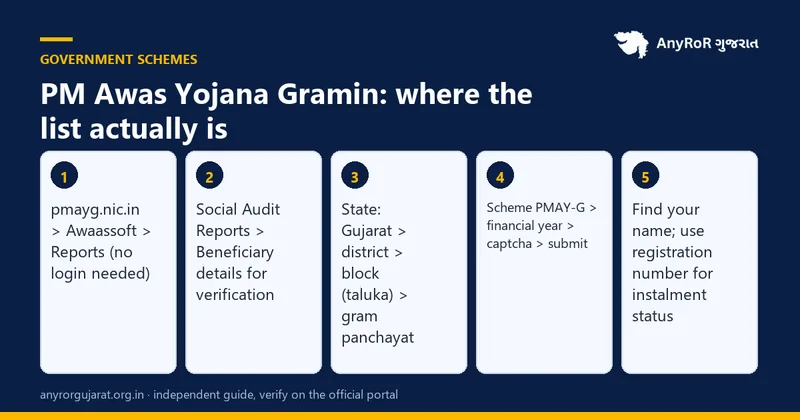
The PM Awas Yojana Gramin (PMAY-G) beneficiary list is published on pmayg.nic.in. To check your name without a registration number, open Awaassoft → Reports → Social Audit Reports → Beneficiary details for verification, choose Gujarat, your district, taluka (block) and gram panchayat, pick the scheme and financial year, and submit. If you have a registration number, use Stakeholders → IAY/PMAYG Beneficiary instead. Names added through the Awaas+ 2024 survey appear once the gram sabha approves the list and the house is sanctioned, so a missing name often means "not yet", not "rejected".
PMAY-G is the central scheme that funds a pucca house for rural families who live in kutcha or dilapidated homes. In Gujarat the scheme runs through the Rural Development Department and the taluka panchayats, and since the 2024 Awaas+ survey a new wave of families has been added. Every month thousands of people search for the "PM Awas Gramin list" to see whether their name is on it, and most of them land on pages that describe the scheme but never show where the list actually lives on the portal.
This guide fixes that. It walks through the exact menu path for the beneficiary list, the registration-number search, the payment status screen (FTO tracking), eligibility under the 2024 survey, the assistance amount and how it is paid, the Gujarat-specific points, and what to do when a name is missing. Figures and screens are as published at the time of writing; the portal is redesigned from time to time, so if a menu label differs, look for the nearest match.
What PMAY-G is and what you get
| Item | Detail |
|---|---|
| Scheme | Pradhan Mantri Awaas Yojana - Gramin, Ministry of Rural Development; restructured from the Indira Awaas Yojana in 2016 and extended as PMAY-G 2.0 for 2024–25 to 2028–29 with a target of 2 crore additional houses |
| Unit assistance | ₹1.20 lakh in plain areas; ₹1.30 lakh in hilly states, north-eastern states, difficult areas and IAP districts |
| Extra support | Up to 90 or 95 person-days of unskilled wages under MGNREGA for construction; ₹12,000 for a toilet under Swachh Bharat Mission (Gramin); convergence for LPG, electricity and water connections |
| Minimum house size | 25 square metres including a hygienic cooking space |
| Payment | Direct benefit transfer to the beneficiary's bank account in instalments linked to construction stages, verified by geo-tagged photographs |
| Ownership | House sanctioned in the name of the woman of the household, or jointly with the husband |
Who is eligible under the Awaas+ 2024 survey
Beneficiaries were originally drawn from the Socio-Economic Caste Census 2011. The Awaas+ list of 2018 added families that were missed, and the Awaas+ 2024 survey, run through the AwaasPlus mobile app with a self-survey option, refreshed the list again. A household is considered if it:
- lives in a house with no walls or roof, or with kutcha walls and roof, or has no house at all; and
- is not excluded by the updated criteria.
The 2024 revision relaxed several exclusion rules. The main exclusions now are:
- Owning a motorised 3- or 4-wheeler, or mechanised farm equipment.
- A Kisan Credit Card with a limit of ₹50,000 or more.
- Any member employed by the government, or earning above ₹15,000 a month.
- Paying income tax or professional tax.
- Owning a refrigerator or landline was removed as an exclusion in 2024, as were smaller land-holding thresholds; the current thresholds are 2.5 acres or more of irrigated land, or 5 acres or more of unirrigated land.
Priority within the list goes to households with no adult member aged 16 to 59, female-headed households with no adult male, households with a disabled member and no able-bodied adult, and landless families depending on casual labour.
How to check the PMAY-G beneficiary list for your village
Step 1 — Open the reports section
Go to pmayg.nic.in. From the top menu open Awaassoft and click Reports. This opens the public reports page (rhreporting.nic.in) without any login.
Step 2 — Choose the beneficiary verification report
Scroll to Social Audit Reports and click Beneficiary details for verification.
Step 3 — Select the location
Pick State: Gujarat, then your District, Block (taluka) and Panchayat. Choose the Scheme (PMAY-G) and the Financial year in which houses were sanctioned; if unsure, check the last 3 years one by one. Enter the captcha and submit.
Step 4 — Read the list
The report lists every sanctioned beneficiary in that panchayat with the registration number, the name, the father's or husband's name, the sanction number and the house status. Use the browser's find function for your name. You can export the list to Excel or PDF.
How to check with a registration number
If you received an acknowledgement at the time of the survey or from the gram panchayat, it carries a registration number. On pmayg.nic.in open Stakeholders → IAY/PMAYG Beneficiary, enter the number and submit. The page shows your details, the sanction, each instalment released and the geo-tagged construction stage. Without the number, click Advanced Search on the same page and search by state, district, block, panchayat, scheme, financial year and name or father's name.
How to check payment status (FTO tracking)
Money moves through a Fund Transfer Order. Open Awaassoft → FTO Tracking, enter the FTO number or your PFMS ID and the captcha, and the page shows whether the order has been generated, signed and credited. Instalments are normally released at these stages:
- After sanction and geo-tagging of the site.
- At plinth level.
- At lintel or roof-cast level.
- On completion, in some states as a fourth tranche.
Each stage needs a geo-tagged photograph uploaded through the Awaas app by the panchayat functionary. If an instalment is stuck, the usual cause is a missing photo or a bank account that failed Aadhaar seeding, not a rejection.
Gujarat-specific points
- The scheme is implemented by the Commissionerate of Rural Development through District Rural Development Agencies (DRDAs) and taluka panchayats. The taluka panchayat's housing branch is the first place to ask about a missing name.
- Gujarat tops up PMAY-G with state schemes for particular groups, such as the Dr. Ambedkar Awas Yojana for Scheduled Caste families and the Pandit Din Dayal Upadhyay Awas Yojana for socially and educationally backward classes, with their own application routes through the e-Samaj Kalyan portal. A family that does not qualify for PMAY-G may qualify for one of these.
- Land: a PMAY-G house needs a site. Landless beneficiaries can be allotted government land or given assistance to buy a plot under state provisions; the taluka Mamlatdar handles the land side. Once a plot is allotted, the family should make sure it appears in the village record; see our rural land record guide.
- Urban areas: families inside municipal limits are covered by PMAY-Urban 2.0 instead, applied for through the municipal corporation or the PMAY-U portal, not through the gramin list.
Why a name may be missing, and what to do
| Reason | Action |
|---|---|
| Surveyed in Awaas+ 2024 but not yet sanctioned | Names move to the permanent waiting list after gram sabha approval and are sanctioned in batches by target. Ask the panchayat for your place on the waiting list. |
| Not surveyed at all | Contact the gram panchayat or taluka housing branch; the self-survey window in the AwaasPlus app was extended in 2025, and grievances about omission can be lodged with the block office. |
| Excluded on a criterion that no longer applies | Request re-verification citing the 2024 relaxed criteria (for example, the refrigerator and landline exclusions were dropped). |
| Name spelt differently | Search by father's or husband's name, or by registration number; then request a correction through the panchayat. |
| Wrong financial year selected | Repeat the report for earlier years; sanctions carry the year they were issued. |
| Already received a house under IAY or PMAY-G | A household is eligible only once; the earlier sanction will show in the beneficiary search. |
Documents to keep ready
- Aadhaar card of the head of household (and consent for Aadhaar-based payment).
- Bank account details, Aadhaar-seeded, in the beneficiary's name.
- Job card number under MGNREGA, if any.
- Swachh Bharat Mission registration number, if a toilet is to be built.
- Proof of the plot: the 7/12 or 8A extract, an allotment order, or the panchayat's site certificate.
- A mobile number for SMS updates.
Frequently asked questions (વારંવાર પૂછાતા પ્રશ્નો)
How do I check my name in the PM Awas Yojana Gramin list 2026?
Open pmayg.nic.in → Awaassoft → Reports → Social Audit Reports → Beneficiary details for verification. Select Gujarat, your district, block and panchayat, the PMAY-G scheme and the financial year, and submit. The list shows names with registration numbers and house status. With a registration number, use Stakeholders → IAY/PMAYG Beneficiary.
How much money does PMAY-G give in Gujarat?
₹1.20 lakh per house in plain areas, paid in instalments to the beneficiary's bank account, plus MGNREGA wages for up to 90 days of construction labour and ₹12,000 for a toilet under Swachh Bharat Mission. Hilly and difficult areas get ₹1.30 lakh.
Who is eligible for PMAY-G after the Awaas+ 2024 survey?
Rural families without a house or living in kutcha or dilapidated houses, who do not own a motorised vehicle or mechanised farm equipment, do not have a Kisan Credit Card of ₹50,000 or more, have no government employee or member earning over ₹15,000 a month, do not pay income or professional tax, and own less than 2.5 acres irrigated or 5 acres unirrigated land.
Can I apply for PMAY-G online myself?
Selection is survey-based rather than by open application. The Awaas+ 2024 survey allowed self-survey through the AwaasPlus app during the survey window. Outside the window, approach the gram panchayat or taluka housing branch to be included in the next verification.
How do I check the PMAY-G payment status?
Use Awaassoft → FTO Tracking on pmayg.nic.in with the FTO number or PFMS ID, or open your record under Stakeholders → IAY/PMAYG Beneficiary, which lists every instalment released.
Why is my name not in the list even though I was surveyed?
Surveyed households go onto a waiting list after gram sabha approval and are sanctioned in batches. Check the report for the latest financial year and ask the panchayat for your position on the permanent waiting list.
Is PMAY-G house registered in the woman's name?
Yes, the house is sanctioned in the name of the woman of the household or jointly with her husband, except where there is no adult woman.
I live in a city. Which PMAY list should I check?
Urban households come under PMAY-Urban 2.0, handled by the municipal corporation and the PMAY-U portal. The gramin list covers only village panchayat areas.
Do I need land to get a PMAY-G house?
A site is needed for construction. Landless families can be allotted government land or assisted to buy a plot under state provisions; contact the taluka Mamlatdar and the panchayat. Once allotted, confirm the plot appears in the village land record.
Is there a PMAY-G helpline?
The Ministry publishes a toll-free number and grievance email on pmayg.nic.in, and Gujarat's Commissionerate of Rural Development lists district contacts. For a specific case, the taluka panchayat housing branch is usually the fastest route.