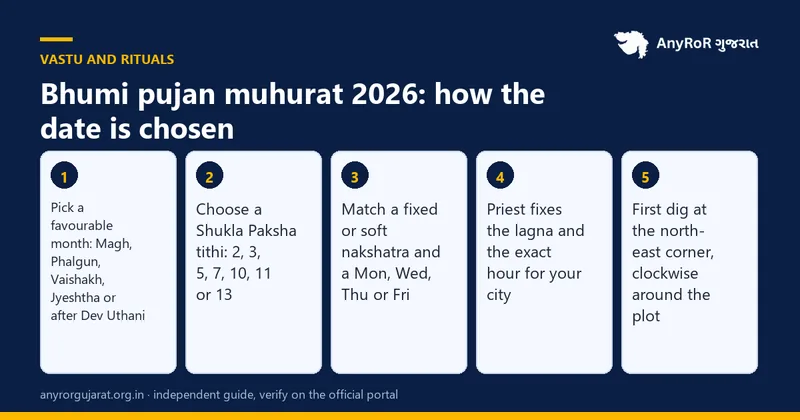
Bhumi pujan (ભૂમિ પૂજન) is the ground-breaking ceremony performed before construction starts. The favourable windows in 2026 fall in Magh, Phalgun, Vaishakh and Jyeshtha (roughly late January to June) and after Dev Uthani Ekadashi in late November and December; Chaturmas, Kharmas, Pitru Paksha and Holashtak are avoided. Choose a Shukla Paksha tithi (Dwitiya, Tritiya, Panchami, Saptami, Dashami, Ekadashi, Trayodashi), a fixed or soft nakshatra (Rohini, Mrigashira, Uttara Phalguni, Uttara Ashadha, Uttara Bhadrapada, Hasta, Chitra, Swati, Anuradha, Revati, Pushya), and a Monday, Wednesday, Thursday or Friday. Confirm the exact hours with a Gujarati panchang or your priest, and have the legal groundwork (NA order, development permission, layout, land record) finished before the first dig.
In Gujarat the bhumi pujan is the day a plot stops being an entry on a 7/12 and starts becoming a house. It is also the day builders, priests, relatives and the JCB operator all need to be free at the same time, which is why families want a date list. This guide explains what the ceremony is and what it is meant to do, the panchang rules that produce a muhurat (month, tithi, nakshatra, weekday, lagna), a month-by-month map of 2026 with favourable and closed windows, the tithis and weekdays in detail, the step-by-step vidhi as commonly performed in Gujarat, the Vastu rules for the first dig, foundation and plot, what happens after the puja, the rashi question, and the documents that must be in order before you break ground. Specific dates are not listed, and the note below explains why.
What bhumi pujan is and why it comes first
Bhumi pujan is a prayer to Bhumi Devi (the earth), to the Vastu Purusha who is imagined lying across the plot, and to the dikpalas (guardians of the directions), asking permission to disturb the ground and blessing the work ahead. It is also the moment the plot's layout is fixed on the ground: the priest and the engineer mark the north-east corner, the first pit is dug, and the foundation line is set. Families who skip it often perform a shorter shilanyas (foundation-stone) puja later; the tradition prefers the pujan before any excavation.
How the muhurat is fixed
The same five panchang limbs govern bhumi pujan as govern griha pravesh (see our griha pravesh guide), with a stronger emphasis on the earth and fixed signs, because a foundation is meant to be permanent.
Months
- Best: Magh, Phalgun, Vaishakh, Jyeshtha. Many families also use Margashirsha after Dev Uthani Ekadashi.
- Acceptable in some traditions: Shravan is favoured for construction starts in parts of north India but not in most Gujarati practice; Ashadh before Devshayani Ekadashi is used when unavoidable.
- Avoided: Chaturmas (Devshayani to Dev Uthani Ekadashi, roughly July to November), Kharmas (solar Dhanu and Meen, mid-December to mid-January and mid-March to mid-April), Adhik Maas, Pitru Paksha, Holashtak, and the days around eclipses.
Tithis
Shukla Paksha Dwitiya, Tritiya, Panchami, Saptami, Dashami, Ekadashi and Trayodashi are preferred, with Purnima acceptable. Krishna Paksha up to Panchami is used when needed. Avoid Amavasya, Chaturthi, Navami, Chaturdashi, and Ashtami in most traditions.
Nakshatras
Fixed (Rohini, Uttara Phalguni, Uttara Ashadha, Uttara Bhadrapada), soft (Mrigashira, Chitra, Anuradha, Revati) and the movable-but-benign Hasta, Swati, Pushya, Dhanishtha and Shatabhisha. Avoid Bharani, Krittika, Ardra, Ashlesha, Magha, Purva Phalguni, Purva Ashadha, Purva Bhadrapada, Jyeshtha, Moola and Vishakha.
Weekdays
Monday, Wednesday, Thursday and Friday. Tuesday is avoided (Mangal, the planet of the earth's fire, is not invited to a foundation), Saturday is avoided by most, and Sunday is accepted by some regional traditions.
Lagna and the earth signs
The priest sets the time in a fixed lagna (Vrishabha, Simha, Vrischika, Kumbha) and, where possible, favours the earth signs Vrishabha and Kanya rising. This depends on the city and the minute and cannot be read from a list.
Month-by-month map of 2026
| Month (2026) | Hindu month | Outlook for bhumi pujan | Notes |
|---|---|---|---|
| January | Paush / Magh | Closed until Makar Sankranti (14 Jan), good after | Magh Shukla Paksha opens the construction season |
| February | Magh / Phalgun | Good | Vasant Panchami is a traditional favourite for foundations |
| March | Phalgun / Chaitra | Mixed | Holashtak before Holi and Kharmas from mid-March close it early |
| April | Chaitra / Vaishakh | Closed until Mesh Sankranti (about 14 Apr), then very good | Akshaya Tritiya is the most-used bhumi pujan day of the year |
| May | Vaishakh / Jyeshtha | Very good | Peak season; book priests and machinery early; plan for heat |
| June | Jyeshtha / Ashadh | Good until Devshayani Ekadashi | Last window before the monsoon and Chaturmas; check for an adhik maas announcement |
| July–October | Ashadh to Kartik | Closed | Chaturmas and the monsoon; excavation is impractical anyway |
| November | Kartik / Margashirsha | Good after Dev Uthani Ekadashi | Labh Pancham and the post-Diwali weeks are popular in Gujarat |
| December | Margashirsha / Paush | Good until Dhanu Sankranti (about 16 Dec) | Kharmas closes the year |
Bhumi pujan vidhi as commonly performed in Gujarat
- Prepare the plot. Clear vegetation and debris, level a small area in the north-east, sprinkle it with water and gomutra or Ganga jal. Mark the plot boundary and the building line with lime.
- Set up in the north-east. A low platform (chowki) with a red or yellow cloth, the kalash with water, mango leaves and a coconut, images of Ganesh and Bhumi Devi, a Vastu Purusha yantra or drawing, and the nine grains (navadhanya).
- Sankalp. The owner (usually the couple) states the intention: the plot details, the purpose of the house, the family's gotra.
- Ganesh puja and punyahavachan. Removal of obstacles and purification of the place and the participants.
- Bhumi puja. Offering to the earth: turmeric, kumkum, flowers, rice, coins, sometimes a silver snake (nag) representing Shesha who bears the earth.
- Vastu Purusha and dikpala puja. The guardians of the directions are invoked; a small offering is placed towards each direction.
- Navagraha and havan. A short fire ritual for the nine planets; the priest may add a Nag puja for the sub-soil.
- The first dig (khanan). The owner digs the first shovel of earth at the north-east corner of the plot (or the north-east of the building footprint), followed by the engineer or mason. Some traditions dig 5 or 9 symbolic pits.
- Shilanyas (optional, same day or later). The first stone or brick is laid in the north-east or south-west foundation trench with the navadhanya, a coin, a piece of copper and a betel nut placed beneath.
- Aarti, prasad and dakshina. Distribute sweets; feed the workers; the family takes prasad home.
The whole ceremony takes 1.5 to 3 hours. Materials are available as a kit from any puja shop; ask the priest for their list, since it varies by tradition.
Vastu rules for the plot and the first dig
- Start digging in the north-east and proceed clockwise to the south-east, south-west and north-west; the north-east should be the lowest point of the plot after excavation and the south-west the highest.
- Borewell or underground tank in the north-east; never in the south-west or south-east.
- Site office, labour huts and material storage in the south-west or west during construction; keep the north-east clear.
- Plot shape: square or rectangular preferred; irregular plots are regularised with a compound wall.
- Slope: ideally falling towards the north or east; fill low south-west corners.
- Trees: heavy trees in the south and west; nothing large in the north-east.
- Building placement: larger margins on the north and east, smaller on the south and west.
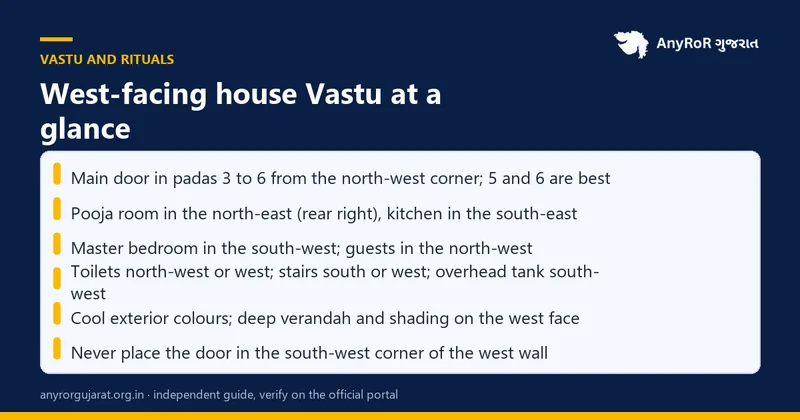
The facing of the plot then determines the door position and the room layout; see the east-facing, north-facing and west-facing house guides.
Bhumi pujan by rashi
Some priests refine the date by the owner's moon sign, avoiding days when the moon transits the 4th, 8th or 12th house from the owner's rashi (chandra bala) and preferring days with tara bala (favourable star count from the owner's birth nakshatra). This is a refinement, not a requirement; families with two owners of different rashis usually choose a date that is at least neutral for both. Give the priest both birth details when you ask for a muhurat.
After the bhumi pujan
- Excavation should begin the same day or within a few days; a long gap between the puja and the dig is discouraged.
- Keep the kalash coconut and the yantra; they are placed in the foundation at shilanyas or kept in the home's pooja room.
- Photograph the marked layout and keep the engineer's setting-out drawing with your file.
- The next ceremonies in the sequence are shilanyas (foundation), slab casting puja (optional), dwar sthapana when the main door frame is fixed, and griha pravesh at the end.
The paperwork that must be done before the first dig
A muhurat does not protect a house built without permission. Before you invite the priest:
- The plot is in your name on the 7/12 or Property Card, with mutation complete and no pending 135-D notice (see the mutation guide).
- The land is non-agricultural, with the NA order for residential use in hand (see the NA permission guide), and the tenure is old tenure or the premium has been paid (see the tenure guide).
- Development permission (building permission) from the municipal corporation, urban development authority or panchayat, with the approved plan.
- The plot's boundaries measured and demarcated (Mojani) if there is any doubt; the layout plot number matches the record.
- Construction labour registered and the contractor's agreement signed; site insurance in place.
- If the plot is in a notified area of a city, the Ashant Dhara permission for the purchase was obtained.
Frequently asked questions (વારંવાર પૂછાતા પ્રશ્નો)
Which months are good for bhumi pujan in 2026?
Magh and Phalgun (late January to early March), Vaishakh and Jyeshtha (mid-April to June), and Margashirsha after Dev Uthani Ekadashi (late November to mid-December). Chaturmas, Kharmas, Pitru Paksha and Holashtak are avoided.
Which tithi is best for bhumi pujan?
Shukla Paksha Dwitiya, Tritiya, Panchami, Saptami, Dashami, Ekadashi and Trayodashi, with Purnima acceptable. Avoid Chaturthi, Ashtami, Navami, Chaturdashi and Amavasya.
Which day of the week is good for bhumi pujan?
Monday, Wednesday, Thursday and Friday. Tuesday is avoided for foundations, Saturday by most families, and Sunday is accepted in some regional traditions.
Where on the plot should the first dig be done?
At the north-east corner of the plot or of the building footprint, then proceeding clockwise. The north-east should end up as the lowest part of the plot and the south-west the highest.
Is Akshaya Tritiya good for bhumi pujan?
Yes. It is treated as an abujh muhurat, auspicious without further calculation, and is the busiest bhumi pujan day of the year in Gujarat.
Can bhumi pujan be done in the monsoon or Chaturmas?
The tradition closes Chaturmas for foundations, and excavation in the monsoon is impractical. If a start cannot wait, some priests permit a simplified puja on Dhanteras or Labh Pancham with the main work after Dev Uthani Ekadashi.
What is the difference between bhumi pujan and shilanyas?
Bhumi pujan is the earth-worship and first dig before excavation; shilanyas is the laying of the first foundation stone, often done the same day or when the trench is ready.
Do I need bhumi pujan for a flat?
No. The developer performs it for the whole project. Flat owners perform griha pravesh at possession.
Why do websites list different bhumi pujan dates?
Tithis and nakshatras start and end at times that differ by city, and lists differ on whether Krishna Paksha or Sunday dates are included. Use the rules to judge any list and confirm the hours with a local panchang.
What documents should be ready before bhumi pujan?
Title in your name on the 7/12 or Property Card, NA order for residential use, development (building) permission with the approved plan, plot demarcation if needed, and any Ashant Dhara or tenure permissions that applied to the purchase.