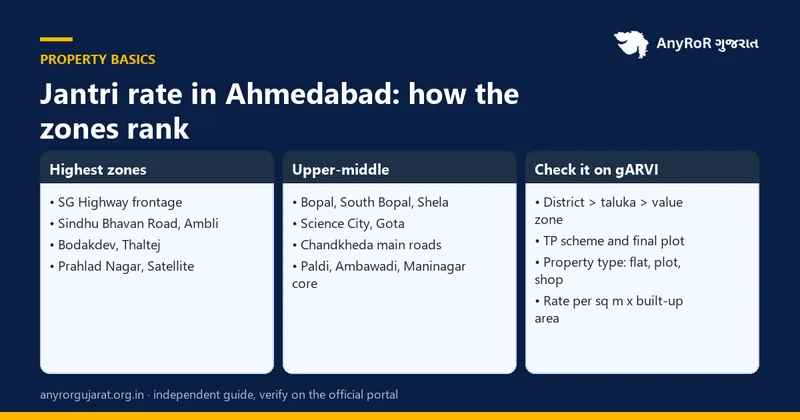
Jantri rates in Ahmedabad are set per value zone, not per locality name, and differ for land, flats, offices and shops. The highest zones are in the western corridor (SG Highway, Bodakdev, Thaltej, Ambli, Sindhu Bhavan Road, Prahlad Nagar, Satellite), mid-level zones cover Bopal, Gota, Chandkheda, Vastrapur and Maninagar, and the lowest zones are in the eastern and peripheral wards. To get the exact figure for a property, open garvi.gujarat.gov.in, choose Jantri, select Ahmedabad, the taluka and the value zone or TP scheme and final plot, and read the rate per square metre. Rates were doubled in April 2023 and a further, location-based revision has been proposed since, so any area-wise list is only a guide; the portal is the record.
Every Ahmedabad property conversation eventually reaches Jantri: "the Jantri is low there", "the Jantri is more than the market price", "duty will be on Jantri". Most people quoting it have never opened the table. This guide explains how Ahmedabad's Jantri is organised, which zones sit where in the ranking and why, what changed in 2023 and what has been proposed since, exactly how to look up a flat, a plot or a shop on gARVI, a worked calculation of value and stamp duty, the cases where Jantri exceeds the market price, the factors that move a zone's rate, and how the figure connects to your Property Card, the AMC tax bill and the RERA carpet area. It builds on our general Jantri guide; this page is the Ahmedabad-specific layer.
How Ahmedabad's Jantri is structured
The Annual Statement of Rates for Ahmedabad city divides the municipal area into value zones drawn along roads and Town Planning (TP) scheme boundaries. Within a zone the table gives separate rates for:
- Open land / plots (residential and commercial), per square metre;
- Residential flats, per square metre of built-up area, with adjustments for floor level, lift, building age and construction type;
- Offices and shops, per square metre, with shops on the ground floor and road-facing frontage rated higher;
- Industrial property in the notified industrial estates.
Because zones follow roads, two flats 200 metres apart can fall in different zones with different rates, and a corner plot on a main road can sit in a higher zone than the interior of the same society. The locality names people use (Bodakdev, Bopal) are approximations of zones, not the zones themselves.
Where Ahmedabad's areas sit in the Jantri ranking
The table ranks the city's familiar localities by the general level of their Jantri zones. It is a guide to relative levels, deliberately without rupee figures, because the exact numbers depend on the zone, the property type and the revision in force on the day you check.
| Band | Localities (typical zones) | Character |
|---|---|---|
| Highest | SG Highway frontage, Sindhu Bhavan Road, Bodakdev, Thaltej, Ambli, Prahlad Nagar, Satellite, Vastrapur (main roads), Navrangpura and CG Road commercial | Premium residential and prime commercial; Jantri for shops and offices is far above residential |
| Upper-middle | Bopal and South Bopal, Shela, Science City Road, Gota, Jagatpur, Chandkheda main roads, Motera, Paldi, Ambawadi, Ellisbridge, Maninagar core | Established and fast-growing residential belts |
| Middle | Ghatlodia, Naranpura, Sola, Ranip, Nikol, Naroda main roads, Vastral main roads, Isanpur, Ghodasar | Dense mid-market housing |
| Lower | Interior eastern wards (Odhav, Ramol, Vatva interiors), walled-city interiors, peripheral villages recently merged into AMC | Older or industrial-adjacent housing; large gaps between Jantri and market in some pockets |
A useful rule: the further west of the Sabarmati and the closer to SG Highway or the SP Ring Road interchanges, the higher the zone. Our posh areas guide and SP Ring Road guide describe these belts in detail.
What changed in 2023, and what has been proposed since
- April 2023: the state doubled all Jantri rates with effect from 15 April 2023, the first change since 2011. Ahmedabad's zone rates therefore rose 100% overnight, which pushed stamp duty bills up sharply in areas where the old rates were already close to market.
- November 2024 onwards: a fresh, survey-based Jantri with far more granular location rates was published for public objections, with much larger increases proposed for prime western Ahmedabad zones and smaller changes elsewhere. Developer bodies and residents filed objections, and implementation has been the subject of announcements and revisions since.
- What this means for you: any article that gives a single "Jantri rate for Bodakdev" is quoting one of at least three possible tables (2011, 2023 doubled, or proposed new). Check which is in force on gARVI on the day of your transaction.
How to check the Jantri rate for an Ahmedabad property
Step 1 — Gather the property identifiers
From the Property Card or the sale deed: the TP scheme number, the final plot (FP) number, the survey number, the ward and the City Survey Office. For a flat, also the building's age and your floor, and the built-up area in square metres (see the carpet vs built-up guide).
Step 2 — Open gARVI and choose Jantri
Go to garvi.gujarat.gov.in and select the Jantri option. Choose District: Ahmedabad, then the taluka (Ahmedabad City for municipal areas; Daskroi, Sanand or Dholka for the fringe villages), then the city, ward or value zone.
Step 3 — Select the property type
Residential flat, open plot, office, shop or industrial. Enter the TP and FP or survey number where asked so that the portal resolves the exact zone.
Step 4 — Read and record the rate
The result gives a rate per square metre and, for flats, the applicable adjustments. Screenshot it with the date. If the portal offers a valuation calculator, enter the area to get the Jantri value directly.
Step 5 — Cross-check
Ask the Sub-Registrar office for the sub-district (they compute Jantri daily) or your document writer to confirm the zone. For a large transaction, a registered valuer's report is worth the fee.
Worked example: a flat in western Ahmedabad
The figures below are illustrative to show the arithmetic, not the current rate for any zone.
| Item | Value |
|---|---|
| Built-up area of the flat | 110 sq m |
| Assumed Jantri rate for the zone (flat) | ₹45,000 per sq m |
| Jantri value | 110 × 45,000 = ₹49,50,000 |
| Agreed price | ₹62,00,000 |
| Base for stamp duty (higher of the two) | ₹62,00,000 |
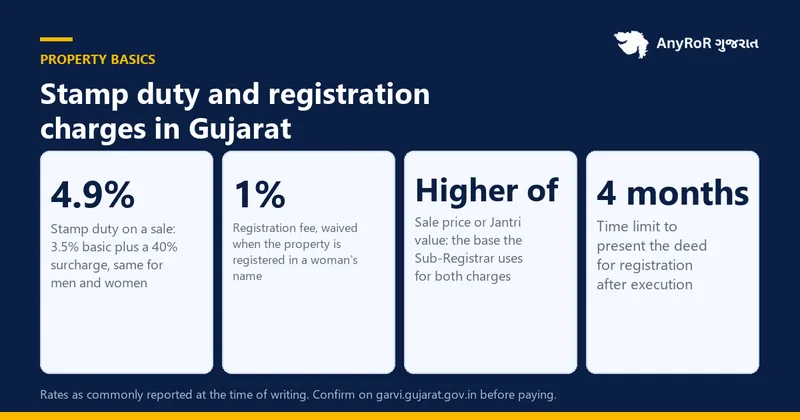
| Stamp duty at 4.9% | ₹3,03,800 |
| Registration fee at 1% (nil for a woman buyer) | ₹62,000 |
Had the agreed price been ₹45 lakh, duty would still be charged on the ₹49.5 lakh Jantri value. Full rules and more examples are in the stamp duty guide.
When Jantri is higher than the market price
After the 2023 doubling this became common in three kinds of Ahmedabad property:
- Old flats in mid-market western societies, where the zone rate reflects new construction on the same road but the 25-year-old building trades lower. The age adjustment helps but does not always close the gap.
- Shops and offices in slow commercial strips, where commercial Jantri is several times residential and the market has not kept up.
- Peripheral plots in newly merged villages, where the zone was drawn generously.
In these cases the buyer pays duty on a value above what they paid, and the seller may face capital-gains tax computed on the Jantri value. The only remedies are to factor it into the price, to request a valuation by the Deputy Collector (Stamp Duty Valuation) in genuine cases, or to wait for a revision that corrects the zone.
Factors that move a zone's rate
- Road width and frontage: main-road zones are rated well above interior zones.
- TP scheme status: finalised schemes with roads and infrastructure rate higher than draft or unplanned pockets.
- Proximity to SG Highway, the SP Ring Road interchanges, the metro corridor and the BRTS.
- Land use permitted in the Development Plan: residential zone R1 versus R2, commercial and mixed-use corridors.
- Recent registered transactions in the zone, which the revision survey uses as evidence.
- For flats: floor, lift, age of building, and whether it is in a high-rise or a low-rise society.
Jantri on your other documents
- Property Card: the e-Milkat card shows a Jantri value field for the plot; compare it with your gARVI lookup.
- Index 2: the registration summary records both the consideration and the market value adopted for duty, so it tells you what Jantri the Sub-Registrar applied to the last sale (see the Index 2 guide).
- AMC property tax: not based on Jantri; the municipal formula uses carpet area and factors (see the property tax guide).
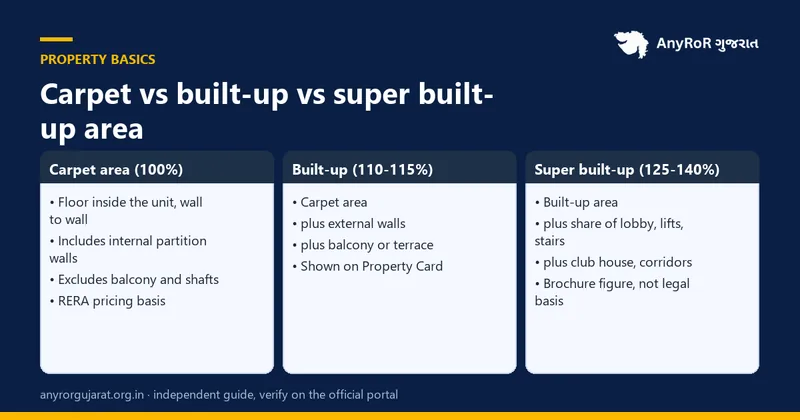
- RERA agreement: priced on carpet area, while Jantri applies to built-up area; the two areas are different numbers for the same flat.
Before you sign in Ahmedabad
- Look up the zone rate on gARVI and compute the Jantri value from the built-up area.
- Budget stamp duty and registration on the higher of price and Jantri.
- Decide whose name goes on the deed; the 1% registration fee is waived for women.
- Check whether the property is in an Ashant Dhara notified area, which adds a permission step (see the Ashant Dhara guide).
- Pull the Property Card and Index 2 to confirm title before paying a token.
Frequently asked questions (વારંવાર પૂછાતા પ્રશ્નો)
What is the Jantri rate in Ahmedabad?
There is no single rate. Ahmedabad is divided into value zones with separate rates for plots, flats, offices and shops. Western corridor zones along SG Highway, Bodakdev, Thaltej and Prahlad Nagar are the highest; eastern and peripheral zones the lowest. Look up your zone on garvi.gujarat.gov.in.
How do I check the Jantri rate for my area in Ahmedabad?
Open garvi.gujarat.gov.in, choose Jantri, select District Ahmedabad, the taluka, the value zone or TP scheme and final plot number, and the property type. The portal shows the rate per square metre; multiply by the built-up area for a flat.
Which area in Ahmedabad has the highest Jantri rate?
The prime western zones: SG Highway frontage, Sindhu Bhavan Road, Bodakdev, Thaltej, Ambli, Prahlad Nagar and Satellite, with commercial zones on CG Road and SG Highway at the top for shops and offices.
Did Jantri rates in Ahmedabad increase in 2023?
Yes. All Gujarat Jantri rates were doubled from 15 April 2023. A further survey-based revision with larger increases for prime Ahmedabad zones was proposed from late 2024 and has been under objection and revision since; check the portal for the table in force.
Is stamp duty in Ahmedabad charged on Jantri or the sale price?
On whichever is higher. Stamp duty is 4.9% and the registration fee 1% (waived for women buyers), both computed on the higher of the agreed price and the Jantri value.
Why is Jantri higher than the market price for my old flat?
Zone rates reflect new construction on the same road, and the 2023 doubling pushed some zones above what older buildings actually fetch. The age adjustment reduces but may not remove the gap; duty is still charged on the Jantri value.
Does the Jantri rate differ for flats and shops in the same building?
Yes, substantially. Commercial rates for shops and offices are several times the residential rate in the same zone, with ground-floor and road-facing shops rated highest.
What is a value zone?
A sub-area of the city, bounded by roads and TP scheme lines, to which one set of Jantri rates applies. Locality names are approximations; the zone boundary decides the rate.
Where is Jantri shown on the Property Card?
The e-Milkat Property Card includes a Jantri value field for the plot. Compare it with your gARVI lookup and with the market value adopted in the last Index 2.
Is AMC property tax based on Jantri?
No. The Ahmedabad Municipal Corporation uses an area-based formula on carpet area with location, age, use and occupancy factors. Jantri affects stamp duty and capital gains, not the annual tax.